Tuesday, January 4, 2011

The Nightmare After Christmas and How I Rang in the New Year

After a busy first few weeks of December spent training in and around Thiès & Dakar, I was prepared to spend Christmas back at site watching holiday movies on my computer and nibbling away at the stash of dark chocolate my friends and family have sent.  With very little arm twisting, however, some of my Peace Corps peeps convinced me that joining them at the beach was a much better idea.  We rented a house in Popenguine, a small beach town on the Petit Côte south of Dakar and spent three days playing in the sand, frolicking in the surf, eating great home-cooked meals, and enjoying a relaxing weekend engulfed in holiday spirit.

Garrison, April, Kelsey, Amy, Clint, and Daisy


Daisy grew up in a traditional Mexican household in Los Angeles and offered to whip us up a Mexican holiday feast on Christmas Eve.  We had carne asada with homemade tortillas, empanitas stuffed with cumin gouda and bacon, homemade salsa, candied yams, arroz con leche, and bissap/mint juice.  I drew upon my own brown roots and contributed a big pot of frijoles.  After dinner, we crowded around a laptop to watch “Love Actually”, a modern Christmas classic, and then changed into nice clothes and headed to the village for midnight mass.  Halfway to town, the electricity went off, which was no big surprise until we arrived at the church to discover that it was not only dark, but locked.  Apparently, midnight mass was held at 10pm and we'd missed it.  We all had a good laugh about it and headed back to the house, stopping along the way to listen to a traditional Senegalese band at the restaurant next door.

Daisy pounding salt

Our glorified camp stove
A failed attempt at Christmas Eve Mass

We awoke the next morning pleased to find that Santa had managed to find us in our little corner of the world.  He’d filled our stockings and snacked on the treats we left him.  An American ex-pat  friend joined us for coffee and Kelsey’s yummy breakfast strata and then we headed back into town a second try at mass.  The service was in French, baby Jesus and the Virgin Mary were black, and the choir, which sung in French, Wolof, and Latin, rocked-out with the aid of drums, hand-clapping, and many African percussion instruments.  It was so much fun to watch.  The tourists from neighboring resort towns joined in to experience Christmas in Africa.

After church we sat by our 6-ft tall wooden giraffe “Christmas tree“ and opened our stockings and presents while eating Kelsey’s cinnamon rolls.  We were all like little kids again.  For most of the people with me, this was their first Christmas away from home or away from their parents.  Their nostalgia was contagious and reminded me of happy childhood Christmases back home.  I have to admit it’s been awhile.


Stockings come in all shapes and sizes

Our Christmas "tree"

Garrison took charge of Christmas dinner and impressed us all with his culinary delights.  He made roasted chicken with a lemon cream sauce, steamed julienne carrots, and bowtie pasta tossed with pesto.  Daisy made homemade eggnog and for dessert I made a trifle.  We so enjoyed these tasty Toubab meals mostly because the ingredients are hard to come by and purchasing them requires a commitment to splurge beyond what our monthly stipends will allow, but also because they were not made under the easiest of circumstances.  Both the electricity and the water were off  more than 50% of the time we were there.  We made due using the gas stove, collecting water in buckets when we could, washing dishes in the surf, and cooking and eating by headlamp and candlelight.  We’re all learning to go with the flow.

Later that evening we had a bonfire on the beach, complete with s’mores, fireworks, and laughter.  It really was a delightful weekend and rejuvenated my belief in holiday happiness.


Christmas Dinner
Garrison & Clint by the bonfire

Garrison & Kelsey ashing dishes in the surf

Stained glass at Christmas Mass


Amy, April, Kelsey, & Daisy
We couldn't have asked for more beautiful sunsets


 If you want to see the whole array of Christmas photos that I posted to my Facebook page, click here : Christmas in Popenguine 

After Christmas, I went back to site for a couple of days and then embarked on my first real project work.  At our All-Volunteer Conference at the beginning of the month, I'd gone on a beekeeping field trip to an apiary near Thiès.  On the bus ride over, I mentioned that I kept bees back in the States and the next thing I know, the trip leaders asked me to help translate and lead the session.  I was so enthralled, that I went back two weeks later, during our In-Service Training to do it again with the Agro-Forestry group.  I asked the beekeeper, Abdou Seck, if he’d be interested in partnering on some training projects and not only did he agree but he wanted to begin immediately.  So, on the 30th of December, I packed up my bags again and joined him on a 3-day beekeeping tour in the Kaolack region, south of Diourbel.


Leading a discussion on beekeeping
Abdou and I with the honey extractor


Inside a hive box


We met up at the garage (car depot) in Diourbel and headed to Kaolack together in a Sept-Place.  Aside from the bumpy road, that leg of the trip was rather uneventful.  We stopped in at Abou’s sister-in-law’s house for lunch and Attaya (afternoon tea) and awaited the car that was supposed to take us out to our destination village.  The driver was delayed and then finally showed up telling us that his car wouldn't make the trip.  Our only other option this late in the day was to take a series of Ndiaga Ndiayes, the ridiculously over-crowded public buses that transport people, livestock, and cargo all at the same time, and stop every couple kilometers to let people on and off.  We boarded the first bus just before dusk and spent the next couple of hours winding our way through small road towns until we finally reached Wack Ngouna.  Each time we stopped to let people on or off was a production.  Women dressed in flowing boubous, carrying sacks of bread, baskets of produce, and/or live chickens had to crawl over the people already seated to reach their empty seats.  Their pathways were blocked by sacks of rice, cases of eggs, and cases of sodas.  As each new person got on the bus, we all scrunched in closer until we were shoulder-to-shoulder and thigh-to-thigh.  The farther out we went, the darker it got, the closer Abdou got pressed against me, and the more tired I grew and irritable.  I started to doubt my choice to join a man I barely knew on a trip out to the hinterlands, especially with his arm now draped around my shoulders.  When we finally arrived in the village it was pitch black because the electricity had gone out.    We were dropped off at the door of small office building where we planned to spend the night.  The guard showed us in and shined his flashlight on the dingy mattress on the floor in the corner of an office where we were both supposed to sleep.  Ok, now I was really doubting my intelligence.  What had I just gotten myself into?  

Without trying to appear panicked, I told Abdou that I would prefer to sleep in the hallway.  I’d brought my Therma-Rest mat and a small Bug-Hut tent with me and would be much happier out there.  He looked at me like I was insane and asked why I would choose to sleep on the floor in the hallway when there was a perfectly “good” mattress for us right there in a room that locked.  I said that I preferred to sleep alone and showed him my mat and tent.  He then pointed to the small space between the mattress and the desk where I could set these up.  “No”, I reiterated.  “I’d really rather sleep alone.  It’s an American thing.  We like our privacy” (all of the above being communicated in my broken French, of course.)  He gave me that “crazy Toubab” look and helped me carry my things into the classroom next door, shaking his head and stating that someone might step on me if I stayed in the hallway.   I quickly set up my sleeping area and was about to settle in when Abdou came into the room, laid his prayer mat at the foot of my tent and started his evening prayer ritual.  So much for privacy.  I guess he was afraid someone would step on him in the hallway.  Who is this someone, I wondered; there was no one there but us and the guard.  Anyway, when he was done praying he got up as if ready to go somewhere (in the pitch dark) and said, incredulously,  “you’re going to go to sleep now?”.    “Yes”, I muttered, and then didn’t add what I was really thinking, “I’m out in the middle of the boonies, in a developing country, with a man I barely know who intended to share a dingy old mattress on the ground with me, it‘s pitch black outside, I haven‘t had dinner, and my headlamp isn’t working,  Yes, I’m going to bed now!”  Again, he just shook his head and went to his room.

With this exhausting day now behind me, I crawled in my tent and hoped that tomorrow would bring better things, as I drifted off to sleep.  Not long after that, however, I felt a hand gently rest on my calf.  “Aack!  Go away!“,…no, I’m just dreaming, I thought.  Then I felt the side of the tent press against my other leg.  “OMG, there’s someone trying to get in my tent!  GO AWAY, LEAVE ME ALONE”, I screamed.  Then, I heard the rattling of the metal door and someone trying to break in.  A flashlight shined at me and someone was yelling in Wolof.  I awoke to find the security guard in his underwear, half asleep, shining his light at me and around the room.  He wanted to know what was wrong, why I was shouting, and who else was in the room with me.  I was quickly awake and overcome with embarrassment, as I realized that I was just having a nightmare.  All I could think to say was “Je dors, je dors” (“I’m sleeping, I’m sleeping”), which the guard thought was ridiculous because, clearly, I wasn’t sleeping.  His flashlight shined on several toads that were hopping around the room and had likely jumped on my legs, serving as a catalyst for the crazy nightmare I just had.  He called Abdou out of his room to come deal with this crazy Toubab and I explained to him that I had just had a nightmare.  When Abdou translated for the guard, they both started laughing at me, and finally left me at alone, both now shaking their heads.

[The next day, I took pictures of the scene to amuse myself.]

The creepy bed on the floor.

My tent set up in the other room.

The toads came back for another visit.


The next morning, the sun was shining and my insecurities were laid to rest. It was a new day.  Abdou, as it turns out wasn’t the creepy old man I’d made him out to be in my state of exhaustion.  His offer for me to sleep with him, was just good old-fashioned Senegalese “teranga” (hospitality to the nth degree) plus a disparity of cultures--women don’t sleep alone, nor do they live alone, and Senegalese people in general prefer to be in the company of others.  I guess I showed him how brave and independent we American women can be!  Ha. 

We started our day with an egg salad sandwich (well, as close as you can get around here) and a cup of coffee.  Sometime thereafter we were met by a guy from the forestry department, several members of the local Environmental Club, and a driver with a truck.   As I’ve learned through many experiences here, nothing ever starts on time.  We were scheduled to begin our tour of surrounding villages at 8am, but didn’t actually leave until after 10am.  I carry a book with me at all times, just for these occasions.  Once we got going though, we had quite an adventure.  Back in June or July, Abdou had been down in this area to give a beekeeping workshop in partnership with a Senegalese NGO (non-government organization).  After the training, men from 36 different villages were given the equipment to start their own apiary (most of them received 8 hives and 4 nukes (smaller starter hives used for capturing wild swarms.)  This tour that we were on was a follow-up to that training.  We visited each village and inspected the installation of the hives:  where they were placed, how many swarms they’d captured, the health of the hive, etc.  We also answered any questions that the new beekeepers had.  This was a really good experience for me for many reasons.  I saw many small rural villages far off the beaten path, visited 225 hives (138 of which were occupied), met some really interesting people who love beekeeping, witnessed an active swarm, and managed not to get stung, even once.  
Inspecting a hive installation

One of the numerous villages we visited
We traveled for three days like this (luckily I got a set in the truck)

Bee-“keeping” is a fairly new concept in this part of Africa, whereas bee-”killing” and bee-”having” have been around much longer.  Bee-killing involves raiding wild hives found in trees by setting fires next to them, smoking out the bees, and destroying the brood in order to obtain the honey.  This practice goes back centuries both in Africa and Asia, results in a smoky-flavored, prematurely harvested honey, and is clearly not a sustainable enterprise.  Bee-having is a step in the right direction and is also widely practiced.  Bees are housed in man-made containers (logs, gourds, or clay pots), but the comb is fixed to the container, not allowing for inspection nor manipulation/maintenance of the hive.  Generally, only the honey comb is removed, which allows the brood comb to stay intact.  The hive is protected and the farmer reaps his reward in periodic honey harvesting.  Bee-keeping, is by far, the most advanced practice but is not yet widely recognized in Senegal.  It implies the management and sustainability of the hive based on an understanding of the bee and can span multiple levels of technological involvement.  It promotes honey production and the health and proliferation of the hive.

On our tour, we were surprised to see many of the new beekeepers combining aspects of their former bee-killing or bee-having practices.  We found hives stacked up in trees, hives suspended upside down or turned on their sides, and hives positioned without protection.  Old habits are hard to break.  We gave each beekeeper advice on how to correct or improve their hive placement and spoke to them about the problems that they faced.  It really was a great learning experience for me, although I have to admit, after the 200th hive, I was starting to get a little bleary-eyed.  It didn’t help that every village we drove into had a crowd of young children who rushed our truck yelling “Toubab! Toubab!” and crowded around me “oohing and ahhing” at the color of my skin.  What first felt a little rock-star-esque, quickly became exhausting and downright unhealthy, as everyone of those kids, although quite cute, had runny noses, visible skin conditions, and probably lice, and by culture, each and every one of them felt obliged to shake my hand.  I emptied my bottle of anti-bacterial gel by the third day.


A group of kids gathering to see the Toubab

Misplaced hives (they're supposed to be on the ground)

And upright!

Rushing the car to catch a glimpse and touch my skin

We headed back to Kaolack late Sunday afternoon, but this time lucked into a Ndiaga Ndiaye that went straight through.  I opted to stay over at our Peace Corps Regional House that night and the next to do a little kitchenware and food shopping since I’m now cooking some meals for myself.  There were quite a few other volunteers there who were staying at the house on their way back from various and sundry New Years celebrations, so I was in good company.  Abdou and I have lined up some more work in the coming months and I have a few other projects that are starting to take root, so those many months of training are beginning to feel purposeful now.

Please take note of the new Photo-A-Day - 2011 link I added to the left side-bar of my blog page or you can click here.  I’m planning to capture a moment from every day in 2011 since it will be the only complete calendar year I’ll spend in service.

Happy New Year to all of you!  Jamm rekk (Peace only!)
Fatou  

Tuesday, November 30, 2010

Tabaski and Thanksgiving 2010

Tabaski 

Our Tabaski Ram
Back home in Virginia, November, brings with it, a chill in the air, an earlier and prolonged evening, and the last of the leaves to fall from the trees.  Here in Senegal, however, it’s still hot, there’s been no time change, and the leaves on the few trees that are scattered about are as green as ever despite the fact that everything around them is dry and brown.  One thing that does feel the same about this time of year, though, is the holiday spirit.  Two months and 10 days after Korité, which this year happened to fall on November 17th, Muslims around the world celebrate, Eid el-Kebir, the Feast of Sacrifice, known in Senegal as Tabaski.  This holiday recognizes Ibrihima’s (Abraham’s) willingness to sacrifice his son Ishmael as an act of submission to God.  At the last minute, however, the Archangel Gabriel made a little switcheroo and replaced his son with a ram.  Lucky for baby Ishmael, apparently it was just the thought that counted.  In celebration of this miraculous event, Senegalese save up their money and purchase one (or many) rams, goats, or cows (depending on their wealth) and slaughter them in the name of Allah.  Families travel great distances and spend more money than they actually have to be together for this celebration.  Even my host mother, Khady, opens her doors to welcome her family of 30 who live next door even though the rest of the year she prefers they stay behind the wall that divides the two households.


Freshly ground pepper over onions
Peeling potatoes


Our ram waiting its fate.

The kiddos watching the sacrifice
Carrying the marinade

Transferring the meat to the cauldron
A feast to behold


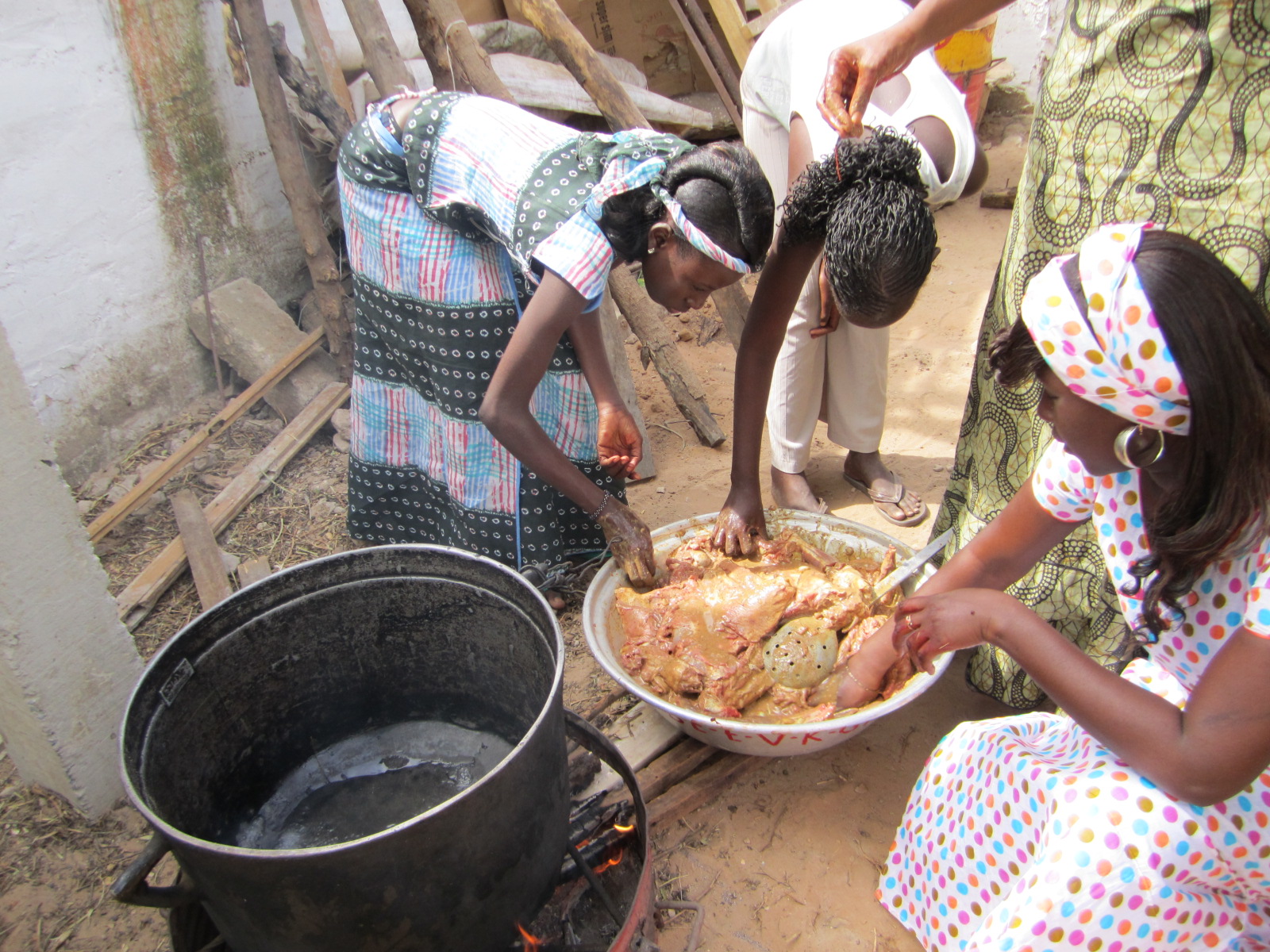
Holiday preparations started the night before when Khady and I sat at an outdoor table in the courtyard and peeled and chopped 10 kilos of onions and 15 heads of garlic.  The next day, we continued with the food preparations: cooking, peeling, and mashing a sack of potatoes, pounding pepper, and making marinade with her nieces.  [NOTE:  THIS IS WHERE YOU SHOULD TURN YOUR HEAD AND SKIP DOWN TO THE NEXT SECTION IF YOU HAVE A WEAK STOMACH.]  Mid-morning, we were summoned next door, where our ram had joined three others, and watched as my uncles said a prayer and, in turn, laid each ram on it’s left side with it’s head facing Mecca, and slit it’s throat over a hole in the sand.  Sorry, sounds gruesome I know and it pretty much was.  Like sleeping dogs dreaming about chasing rabbits, the rams kicked their legs well after they should have stopped moving.  Ghastly noises came from their severed tracheae as their carotid arteries drained into a pool of blood, while, young children gathered round the perimeter to watch.  I hid behind my camera to document the event, hoping that peering through the 2” x 3” screen would make it a little less awful.  The men then very skillfully skinned and gutted the animals and brought the meat back over to our compound for cooking.  Khady and the girls hacked away at the large carcass sections with machetes to make manageable pieces for cooking.


[OKAY, IT’S SAFE TO COME BACK NOW.]  We marinated the mouton (French for sheep) in a blend of Dijon mustard, onion juice, vinegar, and pepper (both black and red); the onions were pulled out of the marinade and cooked to make a sauce.  After tossing the meat in the marinade, we put it in large cauldron to stew over a wood fire before grilling each piece over charcoal.  The meal was served on platters artfully arranged with a big heaping pile of meat in the center, surrounded by onion sauce and dollops of mashed potatoes, then peppered with green olives.  We ate in segregated groups of men, women, and children and used our hands and pieces of bread to feed ourselves.  At my platter, it was not uncommon to see two women tugging at either side of a big piece of meat to free it from it’s bone.  I have to say, tearing into freshly-killed meat like that felt a little barbaric.

After lunch, and I mean immediately after lunch, the food left on the platters was consolidated to one tray and a subgroup of people started eating once again, leaving nothing to spare.  Soon after that, one of my cousins tasked herself with picking meat from the bones of  some other pieces that had been stewing all day and another group of women started deep-fat frying innards.  It was a veritable meat-fest all day long.  Throughout the day, most people were wearing and showing off the new clothes they’d had made for the occasion and almost all of the women were sporting new hair extensions.  These are really big here in Senegal and come in all shapes and sizes.  To my surprise, in the late afternoon/early evening, people began changing into formal attire--I’m talking sequined ball gowns.  Neighbors came a-calling and little kids went house-to-house requesting small treats and money.  As my mom and her nieces sat around her salon de vivre (living room) all dressed up with no where to go, I recalled a now-infamous statement my grandmother once made on Thanksgiving morning several years ago when hours had been spent prepping for an outdoor brunch on a very cold Oregon morning.  After we ate, we were all huddled around a fire, wrapped up in our coats and scarves to keep warm when she looked up and exclaimed, “well, this is just stupid!”   Acknowledging this at some point in the day has become a holiday tradition in my family.


So, that got me thinking about whether Tabaski really is very different than the holiday that we’re used to celebrating at this time of year?  Granted, Thanksgiving is not a religious holiday, but aside from the brief prayer said before the sacrifice (and don‘t most families say some sort of grace before carving into the turkey?), this didn’t feel very religious either.  Families and friends gather together to spend quality time with one another, love is expressed through the sharing of food, and we all put on our fancy clothes to remind ourselves that we can clean up every once in a while.  As Americans, we just tend to sweep the icky part under the carpet and let someone else do our slaughtering for us.  I went to college in Rockingham County, VA, which proclaims itself to be The Turkey Capital and recall watching the horrifying daily migration of semi-trucks loaded with commercially-raised live turkeys headed to the processing plant.  I won’t get on a soap box about eating locally vs. commercially grown foods, but even I, who already has strong feelings in that direction, had my eyes opened a bit as I watched my Senegalese family buy, feed, and care for their meal well in advance of bringing it to their table.  Slow food at its finest.

Click here to view a play-by-play (uncensored) album of my Tabaski experience  (Come on, be brave. There are a lot of great pictures in this album.)

A fancy Thanksgiving
Thanksgiving

Well, lucky for me, I also got to enjoy celebrating an American Thanksgiving here in Senegal.   About 60 Peace Corps volunteers and staff members joined the Ambassador at her residence for a delightfully civilized Thanksgiving feast.  This was my first trip into Dakar that wasn’t an organized event, so that in itself added to the festiveness of it all.  Everyone who came into town traveled individually or in small groups so the arrivals at the regional house were spread out over a couple of days.

I arrived from Thiès with my friend Jackie after we’d both attended a short French workshop earlier in the week.  She was able to show me the ropes on getting into and around Dakar.  Our journey was short (it took just under 2 hours from Thiès), but that included 1) pulling off the highway 6 times to lift the hood of the car to wiggle a few wires so the engine would start again,  2) waiting while the driver got a ticket for going the wrong way down the street, and 3) being yelled at by a street vendor for running over a shoe, luckily there was no foot in the shoe, but the vendor was irritated nonetheless.  Taking all of that into consideration, we made pretty good time and the driver took us directly to our destination--a hotel bar downtown that was serving 2-for-1 happy hour drinks…halleluiah, a real glass of red wine (well, 2 actually!)  I tried my best to ignore the fact that the wine was served cold, because it was served in a real wine glass, with a stem and everything--plus one does not turn down anything cold in this hellaciously hot country.  We met several other PCVs there and one of them had a friend visiting from home (NOTE TO FRIENDS & FAMILY:  This is a mighty fine idea for next year, so give it some thought.)  We dined in a neighboring hotel’s restaurant and had Thai Beef Salads…a nice change of pace from our current diet of rice and fish.

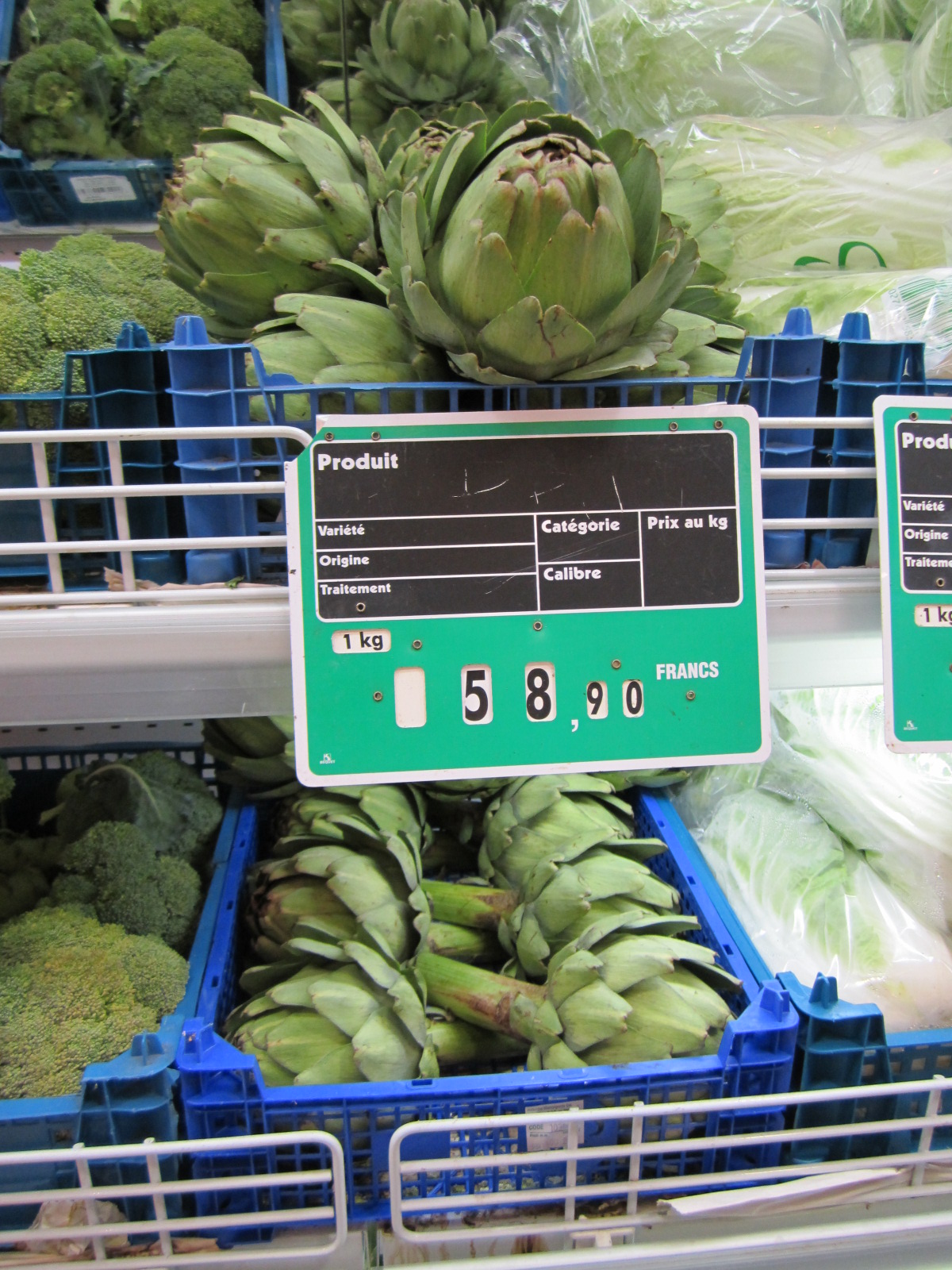
One artichoke = $7 US, aack!
The following day we all planned our side dishes for Thanksgiving dinner and, after a trip to the Peace Corps Headquarters for meeting, we descended up Casino, the French super-grocery store down the street from the office.  O--M--G!  It was glorious.  I’ve never been so dumbstruck in a grocery store before.  By American standards, I have to admit that this was really just an ordinary nice medium sized grocery store, along the lines of Kroger or Giant, but to our deprived eyes, it was like wandering into Willy Wonka’s Chocolate Factory.  Everything was so bright and shiny.  There was a large deli case full of nothing but cheeses and there was a full size produce aisle with things other than carrots, cabbages, and manioc--green things, many many green things.  We spent over an hour in there just wandering up and down the aisles with our mouths gaped open.  A lot of what was offered was ridiculously priced, but it was nice just to know that it’s there, if ever I really want it.  In the end, I maintained restraint and bought only the few things I needed to cook a couple of meals at the Regional house while I was there and make my side dish for Thanksgiving.  I also splurged on a bottle of wine, some hair product, and face lotion.

We arrived back at the house just in time for a regional house costume party.  The invitation requested that we “come dressed as would have been appropriate at the first Thanksgiving ”.  We had some interesting interpretations to that theme and if I had to give out prizes they would have been to:

  • 1st  Prize - Small Pox -- a person covered in colorful hole punch reinforcers who spent the evening “spreading the disease”, targeting the Indians first, of course.
  • 2nd Prize - The Niña, The Pinta, and The Santa Maria -- 3 people decked out in African waxcloth duds patterned with tall ships….and yes, it took many people several hours to realize that they had arrived to dinner a couple of centuries too late.
  • 3rd Prize - A Center-Piece with accompanying candelabra  -- this 3-person costume centered around a bridesmaid‘s dress that arrived in a care package too late for the wedding.
  • Runners Up - to all the Pilgrims, Indians, and Turkeys because they were so creative in the construction of their costumes, and to the Macy’s Day Parade Charlie Brown Float, cause that was thinking outside the box!!

Small Pox scoping out the Indians


PCVs being as un-PC as we can be

The Niña, the Pinta, & the Santa Maria

Waddle she think of next?

Note the traced-hand turkey skirt

Centerpiece with Candelabras


A mighty fine pilgrim hat
A Macy's Parade Float
We make due with what we have..


The next day volunteer and staff kitchens around the city were all aflutter in preparation for our big meal with the ambassador.  I made Moroccan Carrots (see below for recipe), and we had a variety of other tasty vittles, including casseroles, roasted vegetables, mashed potatoes, cornbread, salads, pies, etc…  Although we’d all cleaned up well for our arrival to dinner, the pots and pans we transported the food in had been seen better days.  Luckily, the ambassador’s staff transferred everything to china serving platters and it all looked as lovely as it tasted.  Her Excellency, Madam Bernicat, not only opened her home and provided us with her good company for this event, but she also supplied three golden brown turkeys and an endless supply of chilled wine and freshly brewed coffee.  Ahhh, what an enjoyable evening.  Thank you from the bottom of my heart to all of you good tax-paying American citizens.  That was just the dose of home that I needed.

Making Pasta Salad

Finding our names on the Guest List

A beautifully set table.
Enjoying pre-dinner cocktails


The buffet

Plating up!

Her Excellency capturing a shot


Moroccan Carrots

1 lb. carrots, peeled and sliced
3 cloves garlic, minced
¼ cup olive oil
¼ cup white wine vinegar
½ tsp. cumin
¼ tsp cinnamon
½ tsp. cayenne
¼ tsp. salt
Chopped parsley and/or cilantro

1.  Cooked carrots until just fork tender (al dente).
2.  Mix remaining ingredients (minus the parsley/cilantro) and marinate the carrots in this mixture at room temperature for several hours.
3.  Stir in chopped parsley/cilantro just before serving.

This dish was passed down from my father’s boss Candace.  It’s easy to prepare and carry to a pot luck and is ALWAYS the hit of the party.

Saturday, November 6, 2010

Settling in

Flower outside my window
Now that my agenda is not packed full of daily training courses and Peace Corps-sponsored activities, it’s all starting to feel a bit real.  The days seem longer and hotter and without other Toubabs around, I have to admit, it’s downright lonely at times.  My compound welcomes many neighbors and eco-village members throughout the day and we usually serve 8-10 people lunch, so it’s not that there aren’t people around; I’m just still struggling to communicate with them.  I spend a few hours a week at my tutor’s house conversing in French, but most people around me prefer to speak Wolof.  I know several PCVs who drew the line in the sand at the beginning of their service and refused to learn two languages while they were here, choosing to only communicate with people who would speak French to them.  This seems very tempting, but also pretty isolating, so it’s become clear that I need to commit to learning them both. Two other PCVs who live within a 2 hours drive will be joining me and a Peace Corps language teacher for a Wolof training session next week. Hopefully, that will strengthen my foundation and help me understand the people around me a bit more.

My pen pals at Peabody
That being said, I received my first letter from my French pen pal class in Charlottesville.  I’m participating the World Wise Schools Correspondence Match Program with my friend Maryline and her 6th - 8th  grade French classes at The Peabody School for Intellectually Advanced Children.  Thirteen kids wrote me a short description of themselves and each asked a question about the Senegalese people and their culture to which I’ll respond in my next letter back to them.  We’ve scheduled a Skype call later in the month so Khady and I can talk with them on-line.

Since I’ve not begun any kind of structured, regularly-scheduled work yet, my days are filled with rather mundane things, like reading, cleaning my room, and drinking tea with the neighbors.  I did two weeks worth of laundry this week and got a big ol' blister on my thumb from wringing my clothes out--that was fun.  I also tried to electrocute myself.  I bought this water heater coil thing that plugs into the wall and heats up a cup of water.  I stuck it in my stainless steel French press coffee maker and then, like an idiot, after about 2 minutes stuck my finger in the water to see if it was hot.  I was thrown up against the wall with a powerful jolt and water (yes, it was hot) spilled everywhere. I thought to myself, "well that was just stupid", water--in metal container--with a submerged electrical device, duh! Of course I got shocked.  Not to be defeated, I got up, brushed and dried myself off, and tried again, this time using a durable plastic coffee cup.  When the water started to rumble, I stuck my finger in it again (yes, I really did) and BAM, against the wall I went a second time.  So clearly, I'm thinking, it wasn't the metal vessel that caused the problem, and a few more brain cells died.  I'm beginning to wonder what anyone here is actually going to learn from me.

Thankfully, now that November is here, there’s s finally a touch of coolness in the morning air (that lasts for about an hour or two), so I’ve started doing a 20-min yoga pod cast routine every morning.  That’s been really good for me, as I haven’t had much exercise since I arrived in Senegal and it helps clear my mind and ground me.  The day quickly warms up after that; it’s been well-over 100 degrees everyday since I arrived in Diourbel.  Several times a week, I take a mid-morning walk to the Post Office to see if anyone loves me (hint hint) and along the way, I usually treat myself to a hard-boiled egg that the bean sandwich lady at the train station sells.  After that, I wander aimless through the market trying very hard to embrace my new surroundings but am quickly turned off by all of the vendors who push their wares on me.  The market is not really a place for window-shopping.  You've got to know what you want, where to get it, and get in and out of there fast.

À la Gare (at the train station)
À la Poste (at the Post Office)


My host mother went to visit her sister in Saint Louis this week, so I got to experiment a bit with cooking.  I found some no-boil lasagna noodles in a Toubab store in Kaolak last week when I traveled there for a meeting and decided to try making lasagna in our solar oven.  This was no easy task and it ended up costing me about $20 in ingredients (which is a fortune here).  I have to say, it turned out pretty tasty.  I’d made an entire pan of it and only Ibou and I were around for dinner that night, so now I’m dealing with the leftovers, which is a little tricky because even though we have a refrigerator, the electricity goes out for hours on a daily basis.  The next night I made Salad Niçoise, which also cost a pretty penny, but was equally impressive.  Trying to eat like an American here is not cheap, nor is it easy.  Cooking in Senegal is like cooking while car camping.  You’ve got pots and pans at your disposal, but have to cook everything over a one-burner propane tank in the sandy courtyard, with limited prep station room (I used plastic chairs as my counter tops), and running water but no sink.  People are so in the habit of eating a shared communal platter and welcoming anyone who shows up at their door to eat with them that I was caught off-guard the second night I cooked when two work-mates of my Ibou’s appeared after I’d already plated up two lovely salads.  The invitation I extended for them to join us seemed a little insincere, which I guess it was.  Why hadn’t they shown up the night before when I had a pan full of lasagna?  I couldn't even pull that out for the fridge to heat it up them because our only oven is the solar oven and it was already past dark.. 
My prep station
Assembling the lasagna in the sand

The result of leaning over the saucepan
Falou helping me with the oven
The finished product.


My salad Niçoise

On Halloween, my Ancienne (the PCV whose site I took over) was here helping us with the Solar Oven Marketing workshop, so she and I went to the market in search of pumpkins or squash to carve.  Unfortunately, the squash that is served in Thiéboudienne this time of year is usually sold in individual pre-cut chunks and we couldn’t find a whole one, so we opted for a couple of watermelons and carved those instead.  We explained the concept of Halloween to the workshop participants and they all encouraged us to eat a lot that day, since holidays here are often centered around feasting.


Eco-villagers admiring the Jack-O-Melon

Khady convincing her niece not to be scared

Everyone here is gearing up for the next big holiday, Tabaski, known across the Muslim world as Eid al-Adha (“Festival of Sacrafice”).  According to my Cross Cultural Journal, “Tabaski commemorates the willingness of Ibrahim to sacrifice his son Ishmael in obedience to God.  At the last minute, God provided a ram to be sacrificed instead, in reward for Ibrahim’s commitment.  In commemoration of this event, Muslims around the world celebrate by slaughtering a ram (or goat, cow, etc. depending on the family’s wealth), dividing it into shares, and celebrating with family and friends.  Tabaski occurs approximately two months and ten days after Korite, the end of Ramaden.”

So, in anticipation of this big day, Khady bought two rams last week.  They’re tied up in our kitchen area (because someone thought that was hygienic!) just on the other side of my patio wall.  As one would expect of any animal-loving American, I’ve grown quite fond of them.  They’re tied with short ropes to poles that they keep wrapping themselves around, so I listen for their cries of “Hey, I just wrapped myself around the pole again” and go to their aid.  Aside from their short ropes, they’re treated well by the family.  They’re fed twice a day and are given regular baths.  Last night, I had vegetable scraps from my salad-making and tossed these into their feed tray (the wheelbarrow) thinking I was doing them a favor.  I think one of the rams got a piece of potato skin stuck in its throat as it coughed and make choking noises periodically throughout the night.  It would be just like me to unintentionally kill the Tabaski ram with a touch of kindness.  Thankfully, today, he seems a lot better.
This is our kitchen area.  Note the propane cook stove (red).

My new friends

My tutor's kid with his kid.