Showing posts with label safe zone. Show all posts

Tuesday, January 31, 2012

My Mega Month


What a whirlwind the past month has been.  After spending a lovely Christmas at the beach with a group of friends, I came back to site and started preparing for a busy month.  Since then, I’ve been on-the-go and changing direction almost every day.  It seems that all of my project work has converged at once over the past few weeks.  I won’t bore you with blow-by-blow details, but here are some of my January highlights:
  • Held a T-shirt making class with my Girls Club (shout outs to my mom and sister for the supplies)
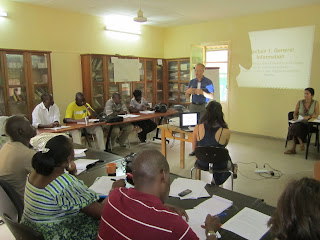
  • Led another round of Safe Zone Training, this time for Volunteers during their in-service training
  • Participated in a 2-day Junior Achievement preparatory training session (this is a worldwide program that “empowers young people to own their economic success”---see http://www.ja.org/ for the US version.)  I’ll be teaching both the high school and elementary school levels of JA classes this year.
  • Attended a 2-day Small Enterprise Development Summit which included sessions on Handicrafts management and Agribusiness, as well as field trips to an Eco-Village, a Food Technology Institute, and a small business administration office in Dakar.
  • Helped coordinate a day-long SeneGAD (Gender & Development) Summit which included talks on HIV/AIDS, working with kids through sports, and presentations from GAD groups visiting from Mali, Guinea, and The Gambia. Also, attended my last SeneGAD Board Meeting and turned over my Communications Coordinator position to two new gals who will now share the title.
  • Participated in two Work Zone Coordinator Meetings to discuss the management of information and project coordination for volunteers in my sub-region.
  • Attended a 2-day All Volunteer Conference where I:
    • participated on a Diversity Panel sharing my experiences being a “Female Volunteer in Senegal” (more specifically, sharing the story of how the police treated me after I was mugged last year);
    • presented a case study on the Gardens of Moringa training I organized with  my friend Andrew last month;
    • demonstrated my Paper Briquette Press during an Appropriate Technology Fair
    •  attended an assortment of interesting sessions on an environmental education club, a school correspondence program, and a beekeeping association in Guinea.
  • Played in the West African Invitational Softball Tournament (affectionately known as WAIST) where Peace Corps regional teams play those from the Marine Corps, the Embassy, USAID, and a number of other ex-pat groups.  By tradition, the Peace Corps teams wear themed costumes which makes it a lot of fun for us. The other teams don’t which makes it less fun for them.
  • Met with the founder of Swahili Imports (http://swahili-imports.com/), a small African arts and handicrafts importer from the lovely Eugene, Oregon, to learn more about the import/export process.  To my delight, not only did I learn a lot, but she was interested in some of Mamadou’s work, so I sent her home with a couple of his wooden plates to show her team.  She’ll be back in a couple of months and I’m keeping my fingers crossed that she’ll place an order.
  • Welcomed Jerry McGahan, a beekeeper from Montana, who came to Senegal on a Farmer-to-Farmer grant funded by USAID.  Together, we:
    • met with the president of the Senegalese beekeeping union and with regional representatives of a  Senegalese NGO organization who are working on a localized honey consolidation project;
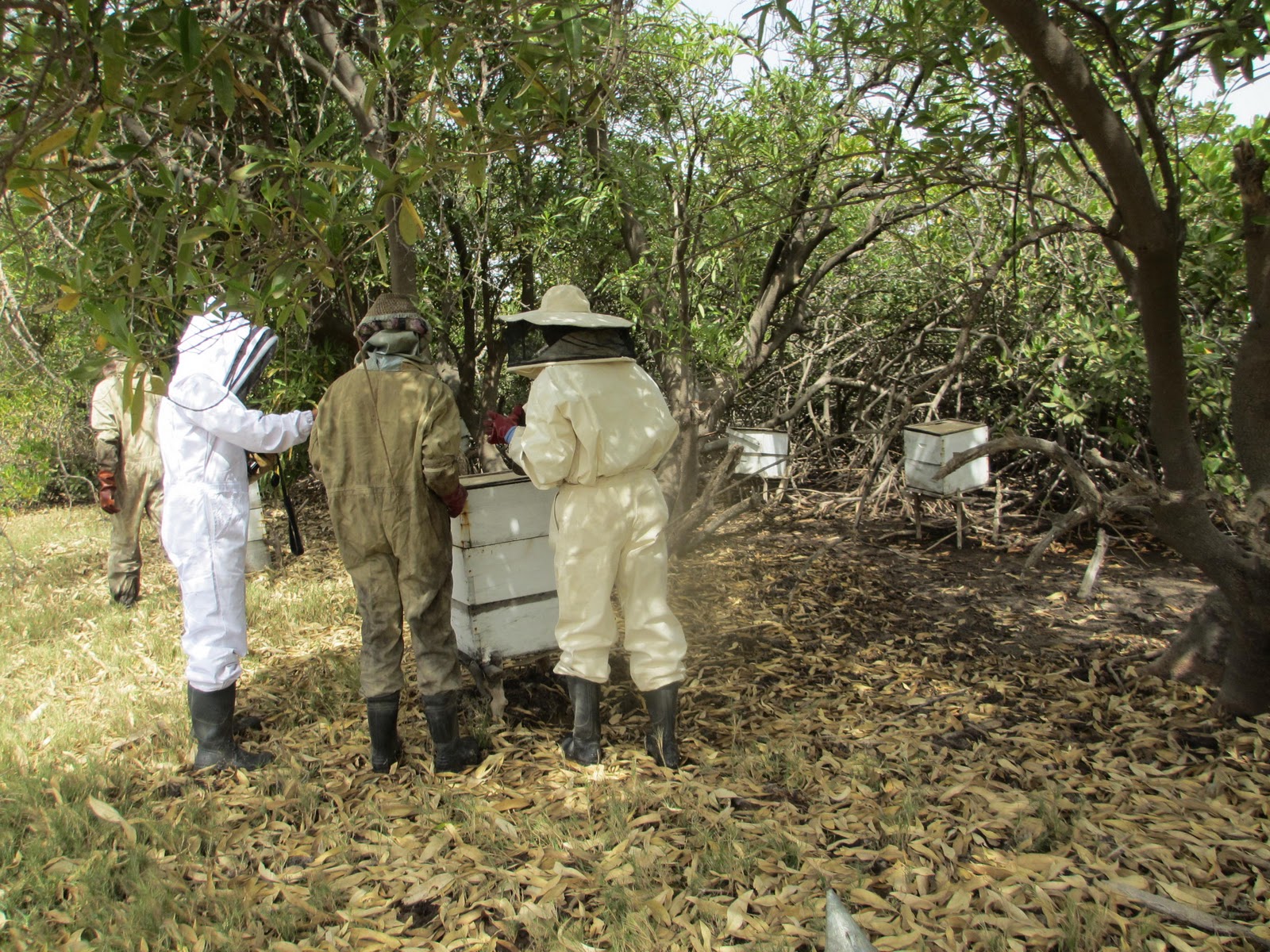
    • visited with several beekeepers in the Thiès and Fatick regions and inspected their hives;
    • visited with potential beekeepers in the Diourbel region and advised them on how to get started;
    • taught young school kids about the importance of pollination and how bees fit into this process;
    • coordinated a craft project with my Girls Club making and decorating bee sculptures;
    • worked on a training presentation that I will later give to Peace Corps Volunteers interested in supporting beekeepers in their regions.
  • Held my first Junior Achievement class with 35 students and 5 teacher assistants at the local technical high school.
  • Coordinated an Eco-Ecole exposition for a delegation of visiting Scout leaders from Finland and Senegal.
Whew!  ALL of that took place over a three week period. I’m exhausted.  Maybe I should just submit this blog entry as my resume when I return to the states.  "If I'm capable of accomplishing that much in just three weeks (in a foreign language), just think what I can do for you!"


Sunday was my first down day since early January.  There was nothing on my calendar and I thoroughly enjoyed every minute of it.  I made a big pot of vegetable barley soup, started a new knitting project, and lost myself in Pinterst for a couple of hours.  It was just what I needed.

Here are some snapshots of events from the last month.

Newly painted t-shirts!


A rockin' solar powered water pump at an Eco-Village


This light and gas stove are fueled by a methane gas
tank which is fueled by this couple's sheep and cows--so cool!


A pedal-powered machine at the food technology institute


Making paper pulp to show the briquette press
at the Appropriate Technology Fair


Panel discussion on Diversity


Les Francais aka Les Dakarois
(Yes, I'm the Eiffel Tower in the middle)


The lovely ladies who replaced me as SeneGAD Communications Coordinator;
yes, it takes two to fill my shoes ;-)


Abdou Seck's honey stand


The Three Amigos - Me, Abdou, and Jerry in Bandia


Meeting up with some more beekeepers down in the delta region


Inspecting hives in the mangroves


Busy little bees.  Aren't they pretty?


Jerry consulting about honey extraction


Mamadou's hopes of selling his products in the U.S.
just may come to fruition.


Beekeeping lesson at our Eco-Ecole


Making bee sculptures with my Girls Club


Soudou and Ibou planning out a future training garden and apiary.


Now that this crazy month has come to an end, it's got me thinking about how I reacted to it.  One of the benefits of living out in the middle of nowhere on my own is that my experiences often shines a light on my idiosyncrasies.  In my little bubble, it's hard not to notice slight behavior changes and quirks. Lately, because I've had too many things on my plate, my office has become littered with piles of project paperwork and supplies and the bags from my last couple of trips still lay unpacked on my bedroom floor.  Thinking back on my life at home, this rang true there, as well.  The busier and more stressed my work life became the more out of control my living space got and the weaker my coping skills became.  Take for example the mouse that recently died in my office. For days, I smelled it, knew it was there, but couldn't deal with digging through the piles of stuff in my office to find it.  Instead, I lit incense and said I'd get to it later.  This is not just laziness, this is not being able to take on one more thing.  My body also tends to shut down when I'm overloaded.  During the midst of this busy period I had to decide whether or not to make an unplanned trip to Dakar to deal with an inner ear problem I was having.  Making the trip meant cancelling some project plans and inconveniencing other people, so I opted not to go. Luckily, with lots of fluids and decongestants the the problem cleared up on its own.


These glimpses into my personality are a good reminder for me to pay attention to them.  My reactions to stress may not change much, but I can probably do a better job of recognizing the signs and using them as a reminder to stop and take a time-out every once in a while.  Ibou and his friends often comment to me that I work too much.  I used to think that my work habits were just exaggerated in contrast to the many rest periods and breaks they take throughout the day, but maybe there's something more innate to it.  I have to remember that there's nothing wrong with closing the laptop, putting down the reference book, and doing something completely recreational for a bit.  This weekend's date with my knitting needles and soup pot were a good reminder of that.  Self-reflection; it's a good thing.


If you're interested in seeing more recent photos, I've added a few new ones to the Photos tab (see tab at top of blog page).  The most recent ones are Christmas in Popenguine v2.011 and  Highlights from WAIST 2012.  I also added some new photos to the albums entitled: Keur Cheikh Girls Club , Skype Snapshots, and the Tangibly Marking the Passage of Time.

P.S. - I did finally look high and low for the dead mouse and, although I didn't find it (I fear it's in the wall, but thankfully, the smell has faded), this new one was waiting for me under my desk the next time I entered my office.  A sacrificial lamb, of sorts.
Thanks for sending the d-CON, Mom.


Friday, July 8, 2011

The Queer Quiz


One of my proudest achievements in service, thus far, did not include attempts to end malaria, to promote nutrition for small children, or even to introduce an alternative fuel source.  No, instead, my moment of glory came in the administration of a quiz---a "queer quiz", to be exact.


At the tail end June, Gay Pride Month in America, five other volunteers joined me at the Thiès Training Center to deliver a day-long seminar on sexual orientation and alternative lifestyles.  Our target audience was a group of local staff members whose job it is to provide language training and cultural support to Peace Corps Trainees.  Also in attendance were other key members of the Peace Corps Senegal staff, including the Training Director, Safety and Security Coordinator, and the Medical Officers.   This training (called Safe Zone Training) was originally put together by volunteers in The Gambia, the small country that cuts through the middle of Senegal, and was shared at our Gender and Development Summit back in February.   It focuses on increasing the staff’s awareness of different sexual identities and instructs them on how to support volunteers that come to them with personal issues.  Homosexual acts are not only considered immoral by the religious leaders here, but they are also punishable by law.  In 2007, 96% of the Senegalese population surveyed said that homosexuality should be rejected by society and, in the past 3 years, 14 Senegalese men have been arrested and 5 imprisoned for illicit homosexual behavior. Just two months ago, several of my friends and I were stunned upon reading a front page news article declaring a “jihad” on  homosexuality, wherein one of the most prestigious religious leaders suggested that those found guilty of this heinous crime be stoned on the streets.

They say that serving in the Peace Corps is the “toughest job you’ll ever love”, but when that job comes with the challenge of masking your true identity for fear of personal harm or imprisonment, as it did for 14% of the volunteers who swore in last year, that makes the job even tougher and, frankly, this just didn’t sit well with me.  I was raised to be open-minded and accepting of people’s differences and I include in my “circle of love” many people whose lifestyles differ from my own.  My mother recalls a phone call she received from me in college after I’d witnessed a KKK march where little kids stood next to their parents holding signs with anti-gay slogans.  I was livid at them; she was proud of me; and yes, I said KKK, as in Ku Klux Klan.  I’m not blind to the fact that discrimination is still alive and well in our great nation, but I’ve never been one to tolerate it.  When I arrived in Senegal, and realized that many of my friends who had been “out” at home had to go back into the closet here in order not to offend their host families or, worse, subject themselves to possible danger or arrest, it made me feel as uncomfortable as they did.  Living in this this foreign culture is hard enough without the added burden of trying to change who you are.  So, I took matters into my own hands and pushed to have this training.

The SeneGAD (Senegal Gender and Development) Board met at the beginning of May and approved my proposal.  Shortly thereafter, we had full support from our Country Director, and we formed a Safe Zone Committee of interested volunteers from around the country to review and modify the training materials we’d gathered.  In less than 2 months, we conducted our first day-long session to 12 attendees.  We covered basic vocabulary, issues faced by homosexual volunteers, current gay rights around the world, the stages and difficulties of coming out, testimonials shared by current volunteers, and anti-gay behavior.   We spent the last hour of the session discussing the definition and role of an “ally” and how our staff can be supportive of volunteers who have issues related to their sexual orientation.  At the end, we passed out the “queer quiz”, which was really just an evaluation form, asking attendees about how their perceptions may have changed from the beginning of the class.   Across the board, the participants demonstrated an increase in understanding and a willingness to discuss these issues.  We had lively and open discussion throughout the day and everyone agreed that this was an topic that no one had felt comfortable broaching before and that this training was long overdue. 
The SeneGAD Safe Zone Team

Our Country Director opened the session to show his support.

It was an interactive training day.

We even had role-play scenarios.
We may not have changed a nation’s attitude, last month, but we connected with a room full of people who provide daily support in the lives of future Peace Corps Volunteers as they struggle to understand a new language and acclimate to a new culture. We “helped promote a better understanding of Americans on the part of the peoples served”, which is the second goal John F. Kennedy defined for the Peace Corps.  Even though most of our participants still hold strong to their religious/legal beliefs regarding these matters, they're open to accepting and supporting others whose beliefs are different from theirs. Like all countries where Peace Corps is present, Senegal is a developing country with a young democracy, so, of course, there is room for improvement when it comes to many rights and the concept of equality.  

Even we, in America, don't quite have this right yet, as we were reminded by the late Coretta Scott King--but we're trying.  “We have a lot more work to do in our common struggle against bigotry and discrimination.  I say ‘common struggle’ because I believe very strongly that all forms of bigotry and discrimination are equally wrong and should be opposed by right-thinking Americans everywhere.  Freedom from discrimination based on sexual orientation is surely a fundamental human right in any great democracy, as much as freedom from racial, religious, gender, or ethnic discrimination.”