Monday, February 20, 2012

Back in the Classroom


Although the school year officially started back in mid-October, it takes a while for things to get going around here.  Children drag their feet about  going back to classes and parents don’t always push them in this direction as it’s difficult to come up with inscription fees and, truth be told, some kids are considered more useful at home.  When things finally do pick up, they are then interrupted by the Muslim and Christian holidays in November and December.  So, in a normal year, the curriculum doesn't really begin to stabilize until January.  This year, however, in addition to the political strife we’ve seen (and maybe even because of it), we’ve had a series of strikes by teacher who are demanding higher pay.  These began in mid-January and just ended last week.  For over a month, public schools have not been functioning.  First, the teachers began a strike and did not show up for class, then the students went on a solidarity strike, and more recently, the teachers have been holding classes for just the first hour and then releasing the kids for the remainder of the school day.

After the initial “snow day” reactions of not having to go to classes wore off, the kids in my neighborhood started their own study groups in the classroom in our compound.  That was nice to see.  Anna, the French volunteer who lived with us for the past few months, tutored a group of young girls in French every morning, and I took on a student who needed help in English.  As the strikes continued, there was talk of having an “Année Blanche” (white year), which meant that school would officially be closed and kids would have to begin again in the same grade next year.  No one was happy about that possibility.  Thankfully, some agreement was made late last week and the kids returned to school full-time this morning.

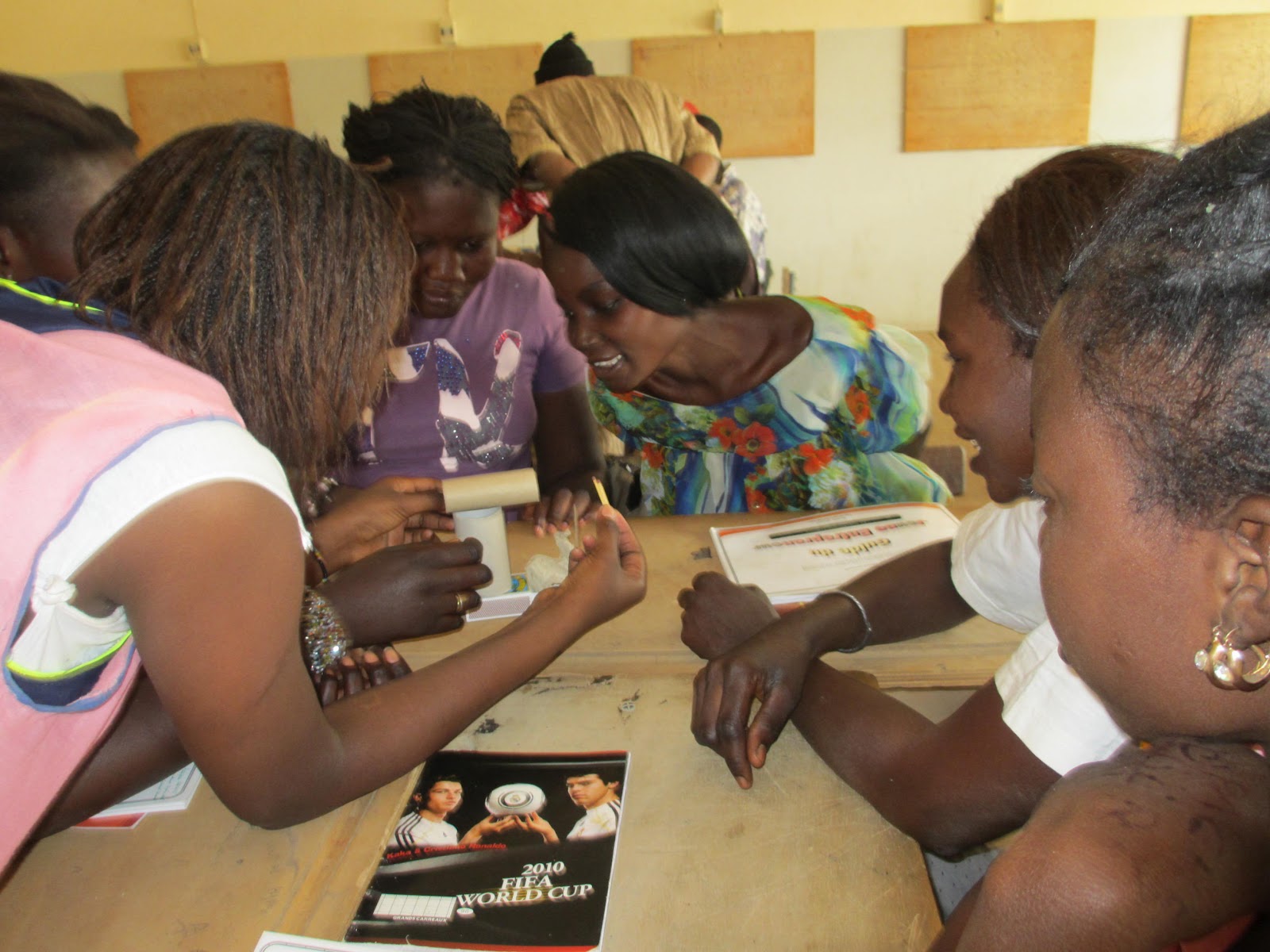
The school where I teach wasn’t affected by the strikes because it’s run by the Department of Justice, rather than the Department of Education.   Why, you ask?  Well, it’s a technical high school and there’s a portion of students who are sent to live there by courts to learn a trade.   Others are there on their own accord, or because they just don’t fit into the regular school system (think, alternative high school).  Maybe I should re-watch that Michelle Pfieffer movie, “Dangerous Minds”, for some tips and pointers?  Anyway, this is where I’m teaching my Junior Achievement “Mini-Entreprise” class.  So far, it’s going fairly well.  I have 36 students from three technical sectors:  home economics, electricity, and metalworking.  I also have 4 teachers helping me out, so that’s helped with keeping the class in order and with much-needed translation.  There are 10 sessions in this course that covers the creation of a small company.  The kids elect a president and a secretary and form a board of directors.  They choose a product or service for their company and learn how to conduct proper meetings, deal with human resource issues, conduct a market study, understand costing/pricing, and develop a logo, among other things.

As I blogged about last year, teaching in the developing world is rife with challenges. The classroom is an empty, dusty room, with only a wooden chalk board and simple two-seater desks.  The first thing I did when starting this course is rearrange the desks so that the students would be sitting in groups.  This was a new concept for them, but they’ve embraced it and have been fairly good about working together in teams.  You cannot assume that kids will show up to class with pen and paper, and, I was surprised to discover, this holds true for the teachers who are helping me, as well.  Textbooks are a rarity, so it's a special treat for these kids to get the ones for this course that were supplied by Junior Achievement.  The pace of class is slow, for many reasons.  One reason is that getting the kids to show up on time is like pulling teeth.  Even the teachers who are working with me are hesitant to round up the students who are often milling about outside the classroom 20 minutes after the scheduled class start time.  Another reason is that everything I say in French, has to be translated and repeated in Wolof by one of the other teachers.  Also, kids are very deliberate about copying everything down, and they take great pride in their handwriting, so even passing around an attendance sheet can take up the first 15 minutes of class time.  One of the requirements of the program is that I submit a report with each kid's name, birth date, place of birth, and signature in order for their certificates to be created.  Sounds simple enough, but it's not.  25% of my class did not know where or when they were born.  The same held true in the Junior Achievement class I'm holding with a group of younger kids, but the numbers there were even higher, over 60% of the elementary school-aged kids did not know this information.  You can rest assured that nobody will be bringing in cupcakes for the class on their birthday.


A stark classroom
Working in groups


Teamwork
Visiting American grad students who
visited my class last week.

As I just mentioned, I've also been able to involve the kids in our Eco-Ecole in the Junior Achievement program.  These are the kids who meet at our compound every Saturday morning and who I've been working with on the paper briquette project.  Junior Achievement has developed a shorter program for elementary school-aged kids that runs for just 5 sessions and focuses on the concept of Community Economics.  In this course, we focus on the roles people play in the community, how the government and the private sector interact, and how money flows through a community.  Some of the classroom behaviors that I've noticed in my high school class are present with this group, as well, and there are some other interesting similarities.  Because we do a lot of group work, the groups are often competing with one another in activities.  I come prepared with candy prizes for the winning teams.  Last week, I witnessed an interesting phenomena in both of my classes.  The winning teams not only shared their winnings with each other, but then shared them with the rest of the class as well.  This was more easily accomplished in my high school class, as I gave the winning team a box of Nerds.  They passed it around so that everyone got at least a couple little pieces.  In the Eco-Ecole group, I gave each person on the winning team an individually wrapped Life-Saver.  I stood in awe, as they opened the cellophane wrappers and then bit each Life-Saver into several smaller pieces so they could share them with the kids on the other teams.  Forget the striking and cupcakes, now THAT'S solidarity!


This kids in this 12 second video are saying "Madamadamada.... (or Madame, Madame, Madame).  
The alternative is Meshurmeshurmeshur...(or Monsieur, Monsieur, Monsieur).  
This practice (and the snapping of fingers) is common in classrooms when kids want to be called upon.  
To me, it conjures up images of baby birds in a nest waiting to be fed.

P.S. - Check out the my recently updated Spare Time page to see the results of my latest crafting-craze.

Tuesday, January 31, 2012

My Mega Month


What a whirlwind the past month has been.  After spending a lovely Christmas at the beach with a group of friends, I came back to site and started preparing for a busy month.  Since then, I’ve been on-the-go and changing direction almost every day.  It seems that all of my project work has converged at once over the past few weeks.  I won’t bore you with blow-by-blow details, but here are some of my January highlights:
  • Held a T-shirt making class with my Girls Club (shout outs to my mom and sister for the supplies)
  • Led another round of Safe Zone Training, this time for Volunteers during their in-service training
  • Participated in a 2-day Junior Achievement preparatory training session (this is a worldwide program that “empowers young people to own their economic success”---see http://www.ja.org/ for the US version.)  I’ll be teaching both the high school and elementary school levels of JA classes this year.
  • Attended a 2-day Small Enterprise Development Summit which included sessions on Handicrafts management and Agribusiness, as well as field trips to an Eco-Village, a Food Technology Institute, and a small business administration office in Dakar.
  • Helped coordinate a day-long SeneGAD (Gender & Development) Summit which included talks on HIV/AIDS, working with kids through sports, and presentations from GAD groups visiting from Mali, Guinea, and The Gambia. Also, attended my last SeneGAD Board Meeting and turned over my Communications Coordinator position to two new gals who will now share the title.
  • Participated in two Work Zone Coordinator Meetings to discuss the management of information and project coordination for volunteers in my sub-region.
  • Attended a 2-day All Volunteer Conference where I:
    • participated on a Diversity Panel sharing my experiences being a “Female Volunteer in Senegal” (more specifically, sharing the story of how the police treated me after I was mugged last year);
    • presented a case study on the Gardens of Moringa training I organized with  my friend Andrew last month;
    • demonstrated my Paper Briquette Press during an Appropriate Technology Fair
    •  attended an assortment of interesting sessions on an environmental education club, a school correspondence program, and a beekeeping association in Guinea.
  • Played in the West African Invitational Softball Tournament (affectionately known as WAIST) where Peace Corps regional teams play those from the Marine Corps, the Embassy, USAID, and a number of other ex-pat groups.  By tradition, the Peace Corps teams wear themed costumes which makes it a lot of fun for us. The other teams don’t which makes it less fun for them.
  • Met with the founder of Swahili Imports (http://swahili-imports.com/), a small African arts and handicrafts importer from the lovely Eugene, Oregon, to learn more about the import/export process.  To my delight, not only did I learn a lot, but she was interested in some of Mamadou’s work, so I sent her home with a couple of his wooden plates to show her team.  She’ll be back in a couple of months and I’m keeping my fingers crossed that she’ll place an order.
  • Welcomed Jerry McGahan, a beekeeper from Montana, who came to Senegal on a Farmer-to-Farmer grant funded by USAID.  Together, we:
    • met with the president of the Senegalese beekeeping union and with regional representatives of a  Senegalese NGO organization who are working on a localized honey consolidation project;
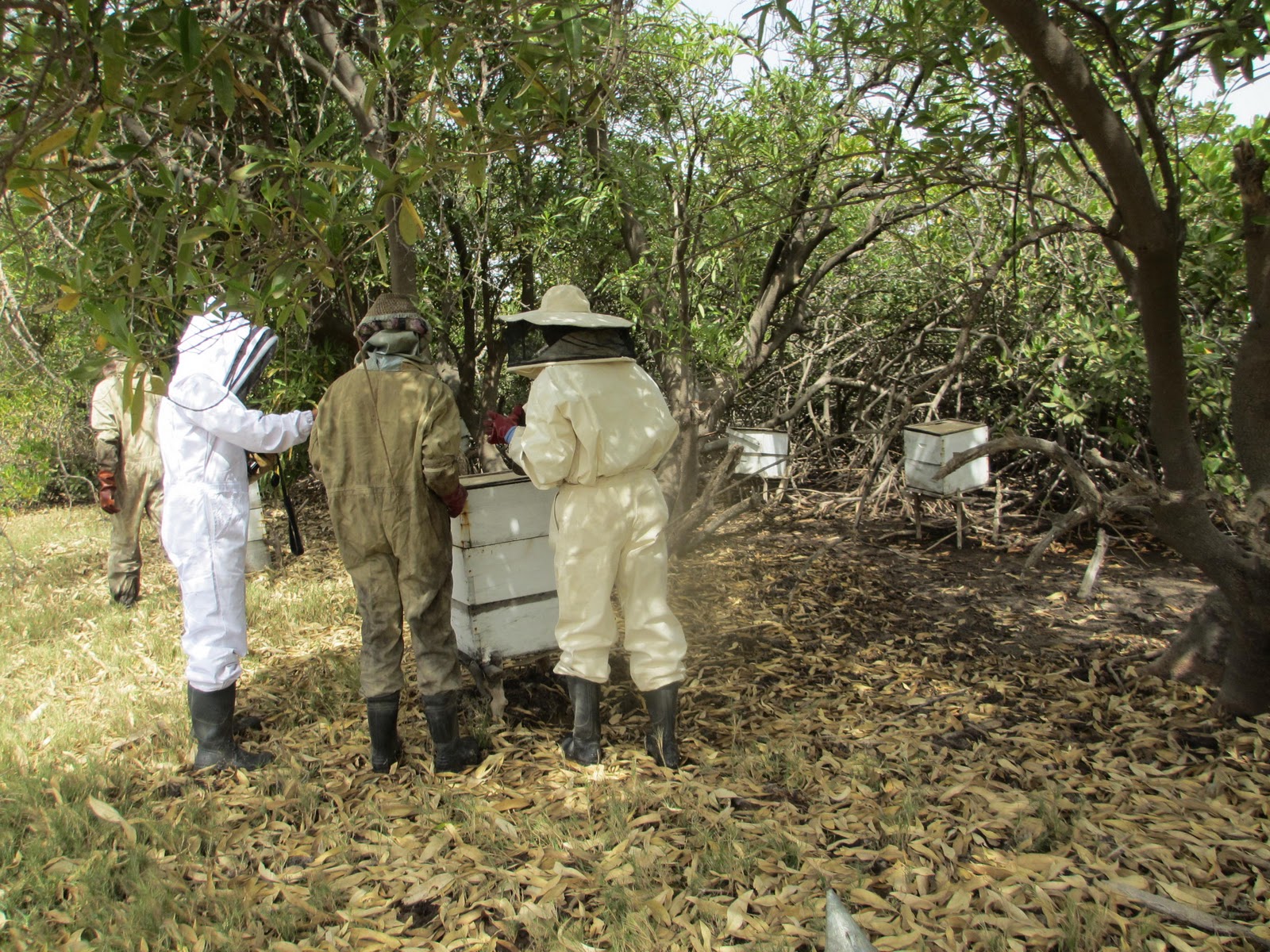
    • visited with several beekeepers in the Thiès and Fatick regions and inspected their hives;
    • visited with potential beekeepers in the Diourbel region and advised them on how to get started;
    • taught young school kids about the importance of pollination and how bees fit into this process;
    • coordinated a craft project with my Girls Club making and decorating bee sculptures;
    • worked on a training presentation that I will later give to Peace Corps Volunteers interested in supporting beekeepers in their regions.
  • Held my first Junior Achievement class with 35 students and 5 teacher assistants at the local technical high school.
  • Coordinated an Eco-Ecole exposition for a delegation of visiting Scout leaders from Finland and Senegal.
Whew!  ALL of that took place over a three week period. I’m exhausted.  Maybe I should just submit this blog entry as my resume when I return to the states.  "If I'm capable of accomplishing that much in just three weeks (in a foreign language), just think what I can do for you!"


Sunday was my first down day since early January.  There was nothing on my calendar and I thoroughly enjoyed every minute of it.  I made a big pot of vegetable barley soup, started a new knitting project, and lost myself in Pinterst for a couple of hours.  It was just what I needed.

Here are some snapshots of events from the last month.

Newly painted t-shirts!


A rockin' solar powered water pump at an Eco-Village


This light and gas stove are fueled by a methane gas
tank which is fueled by this couple's sheep and cows--so cool!


A pedal-powered machine at the food technology institute


Making paper pulp to show the briquette press
at the Appropriate Technology Fair


Panel discussion on Diversity


Les Francais aka Les Dakarois
(Yes, I'm the Eiffel Tower in the middle)


The lovely ladies who replaced me as SeneGAD Communications Coordinator;
yes, it takes two to fill my shoes ;-)


Abdou Seck's honey stand


The Three Amigos - Me, Abdou, and Jerry in Bandia


Meeting up with some more beekeepers down in the delta region


Inspecting hives in the mangroves


Busy little bees.  Aren't they pretty?


Jerry consulting about honey extraction


Mamadou's hopes of selling his products in the U.S.
just may come to fruition.


Beekeeping lesson at our Eco-Ecole


Making bee sculptures with my Girls Club


Soudou and Ibou planning out a future training garden and apiary.


Now that this crazy month has come to an end, it's got me thinking about how I reacted to it.  One of the benefits of living out in the middle of nowhere on my own is that my experiences often shines a light on my idiosyncrasies.  In my little bubble, it's hard not to notice slight behavior changes and quirks. Lately, because I've had too many things on my plate, my office has become littered with piles of project paperwork and supplies and the bags from my last couple of trips still lay unpacked on my bedroom floor.  Thinking back on my life at home, this rang true there, as well.  The busier and more stressed my work life became the more out of control my living space got and the weaker my coping skills became.  Take for example the mouse that recently died in my office. For days, I smelled it, knew it was there, but couldn't deal with digging through the piles of stuff in my office to find it.  Instead, I lit incense and said I'd get to it later.  This is not just laziness, this is not being able to take on one more thing.  My body also tends to shut down when I'm overloaded.  During the midst of this busy period I had to decide whether or not to make an unplanned trip to Dakar to deal with an inner ear problem I was having.  Making the trip meant cancelling some project plans and inconveniencing other people, so I opted not to go. Luckily, with lots of fluids and decongestants the the problem cleared up on its own.


These glimpses into my personality are a good reminder for me to pay attention to them.  My reactions to stress may not change much, but I can probably do a better job of recognizing the signs and using them as a reminder to stop and take a time-out every once in a while.  Ibou and his friends often comment to me that I work too much.  I used to think that my work habits were just exaggerated in contrast to the many rest periods and breaks they take throughout the day, but maybe there's something more innate to it.  I have to remember that there's nothing wrong with closing the laptop, putting down the reference book, and doing something completely recreational for a bit.  This weekend's date with my knitting needles and soup pot were a good reminder of that.  Self-reflection; it's a good thing.


If you're interested in seeing more recent photos, I've added a few new ones to the Photos tab (see tab at top of blog page).  The most recent ones are Christmas in Popenguine v2.011 and  Highlights from WAIST 2012.  I also added some new photos to the albums entitled: Keur Cheikh Girls Club , Skype Snapshots, and the Tangibly Marking the Passage of Time.

P.S. - I did finally look high and low for the dead mouse and, although I didn't find it (I fear it's in the wall, but thankfully, the smell has faded), this new one was waiting for me under my desk the next time I entered my office.  A sacrificial lamb, of sorts.
Thanks for sending the d-CON, Mom.


Thursday, December 15, 2011

Wait...This Is Beginning To Feel Like a Real Job


It’s been 2 months since my last blog entry and I've been on-the-go the entire time.  They say that your project work picks up after the first year of Peace Corps service, and apparently “they” know what they’re talking about.  This is beginning to feel like a real job all of a sudden!
Before the rush began, I took my second vacation of the year and spent 3 weeks back in the states visiting with friends and family and enjoying the splendors of autumn in Virginia.  Although I wasn’t able to catch up with everyone I’d hoped to, I did see quite a few people and many a four-legged friend.  Being home wasn’t as overwhelming as my trip to Europe this past summer.  I’d already experienced the shock of the modern world and my mind was no longer making comparisons with everything I saw.  In fact, it was more like I’d landed on a different planet, Planet America, and therefore I didn’t expect for things to be the same.  I did have a few first impressions, though.  It seems I’ve spent the better part of a year telling Senegalese folks who are enthralled with the idea of the U.S. that America is not really like it appears on T.V.  After having been back just a day, I realized that, well, it actually kind of is--clean, pretty, organized, and filled with things that cost a lot of money.  I guess I’ll have to change my tune on this and just accept it for what it is.  The other things that caught my eye were the little trends that had popped up since I’ve been gone.  Everywhere I looked there was Greek yogurt, scan squares, Angry Birds, and eyebrow threading.  Odd, what catches on so quickly.  Other than that, home was pretty much like I left it.  I filled my days sightseeing, walking in the woods, enjoying the company of friends and family, hanging with my dog, attending a film festival, eating good food, sipping tea, drinking good coffee, and appreciating fine libations.  I overextended myself a bit with all of the socializing I tried to fit in, so by the time I left I was fighting a cold and cough, but it was totally worth it.  How often to you get to be a vacationing visitor in your own home-town?  Click on this photo to open an album with pictures from my trip.
Special thanks go out to the many friends and family who hosted me while I was back.  It was a bit strange not to have a home to return to, but the hospitality extended to me was grand and I was happy to see that my renters are taking great care of my house in Batesville.  Also, a big “merci” goes out to The Peabody School for holding an assembly so I could tell them all about my adventures in the Peace Corps.  After the assembly, I spent an hour with the kids from the French classes with whom I’ve been corresponding and it was really great to meet them in person.  Then there are folks who came to the Cider Dinner at my friend Kevin’s house, who were gracious enough to donate almost $800 to my “Bringing Books to Senegal” campaign.  This is a project I was working on with a group of volunteers in Senegal.  We were teaming up with the non-profit organization, Books for Africa,to raise funds to bring over 22,000 local language books and text books to local libraries and schools Senegal.  Unfortunately, I just found out this week, that the campaign has been cancelled, as the request for funds has exceeded the time limit allotted.  Never fear, the $4,400 already donated to this project will be diverted to the Peace Corps Marathon fundraiser whose proceeds will be going to a scholarship program for middle school girls.  I’ve been involved with this scholarship program for some time and, in fact, some of the recipients of this year’s scholarships are the ones who attended our Girls Leadership Camp in September.  Click here for a clever video clip promoting the Peace Corps Race for Education Marathon.   Although I'm not planning to train for this race (are you kidding me?!?!--I struggled to train for a 5K while I was home and this is taking place in Sub-Saharan Africa!), I do plan to go down to cheer on those brave souls who will be running and make sure everyone stays hydrated.
On 11-11-11, just a couple of days after returning to Senegal, I organized a World Hoop Day celebration to spread my joy of wiggling and giggling (aka hoop dancing) with the people in my community.  World Hoop Day is a non-profitorganization based in the U.S. that granted me funds to make a slew of hoops for the kids of Diourbel.  I teamed up with my friend Nar Dieng, who heads a roller-blading association, to put on a grand spectacle for the kids.  A local youth center donated the space and Nar and his friends helped me make and decorate 50 new hoops for this event.  A couple of Peace Corps Volunteers from neighboring villages came in for the day to help me out and several school officials came to partake in the festivities.  We had well over 70 kids join us for an afternoon of hooping and roller-blading.  The local radio station even covered the event in their evening broadcast.  Aside from the usual annoyances, like having to transport chairs and hoops on the back of a horse-drawn cart, people showing up late, and a sound system that was many decibels too loud, everything came together and it was a fun-filled afternoon. Click on the picture below to open an album of photos from the event.

World Hoop Day


The following week, I gathered a training group in Dakar to conduct another round of Safe Zone Training to discuss gay awareness and sensitivity with our local Peace Corps staff.  This was our third round of training and was, again, well-received.  This always provokes lots of discussion and controversy, but that’s why we put it together in the first place. We give the staff a safe place to talk about these issues and to better understand how to support homosexual volunteers who are serving in a country where homosexual acts are treated as both immoral and illegal.  During this session, one of the staff members shared with us her concerns about an Islamic belief that if you touch a homosexual, even a casual touch upon the arm, then your prayers will not count for 40 days.  Since Muslims pray 5 times a day, that’s 200 prayers down the drain.  She understood that she has a professional obligation to interact with homosexual volunteers, but wanted to make it clear to us that she was uncomfortable with this.  Fair enough—we weren’t there to change their opinions, just broaden their understanding and hopefully identify some folks who could step up to provide support.  Regardless, it was hard to hear.  Soon after this discussion, however, one of our openly gay volunteers returned a pen to another participant and to thank him for remembering to give it back, she hugged him.  Yes, right there in front of Allah and everybody, with 200 prayers in jeopardy, she hugged him. It was beautiful.

The next week I returned to Dakar to attend a Thanksgiving feast at the home of the new Ambassador and his wife, Lewis and Lucy Lukens.  They arrived in Senegal in August and were brave enough to follow in the tradition of previous ambassadors and invite the Peace Corps Volunteers over to their house to celebrate the holiday. I say brave, because letting a group of mostly 20-somethings who’ve been living meager lives subsisting on rice and millet for many months around unlimited amounts of good food and wine can be a scary sight.  Many volunteers chose to stay in their respective regions, hosting smaller gatherings at regional houses, but there were still over 100 volunteers who signed up for the pot luck in Dakar.  In addition, 30 or so embassy employees joined us, so it was quite an impressive gathering (that’s a lot of toubabs) and the food was amazing.

Stanzi rolling out pie dough with a beer bottle--classic Peace Corps ingenuity!
An impressive variety of foods at the pot luck

One of the MANY long tables set up for the event.


So I over-indulged a little!


The Tivaouane gang had a Thanksgiving reunion of sorts.
Phil, Kelsey, April, and Chris

The following day, a small group of volunteers hosted a Black Friday Art Expo in Dakar.  I brought two artisans from Diourbel: Mamadou, who I’ve introduced before, and Dibor, a new tailor with whom I’m working.  She and I designed some satchels and bags made from recycled rice sacks and these sold really well.  I also worked with her to create some other new items that we thought would interest the ex-pat community of Dakar.  She made placemat and napkin sets, adjustable aprons, and wrap-pants.  Dibor sold so many things the first day of the Expo that she stayed up late at her sewing machine that night to replenish her stocks.  In the first two days of the sale, she netted well over $200, which in an economy where people survive on less than $1/day, is pretty substantial.  Her husband called me later that week to thank me personally.

Dibor at the Art Expo
Dibor's rice sack bags
Mamadou and his friend Matar

Hanging with my artisans

Khady returned to France at the end of November and won’t return to Senegal until after my service has ended.  I’m going to miss having her around, although it will be nice for Ibou and me to have the compound back to ourselves.  This time around we’re not exactly alone though.  We now have a young French volunteer named Anna who has just started working with us.  She arrived in Senegal a few weeks ago and will likely stay for the three months that her visa will allow.  So far, she’s settling in and getting used to the heat, culture, and language.  That’s a lot to come at you at once, I know.  Soon, she’ll be helping us with our Eco-Ecole program and our village garden projects.  Although she doesn’t speak a lick of English and my ears strain to understand her accent (so different for the African French accent), it’s nice to have another toubab around.  Her arrival was also a good excuse not to return to eating lunches with the family across the street.  As much as I enjoyed their company, I’m happy not to be forced to eat my weight in rice every day.

Another welcome change that’s occurred since my return from the States is that we’ve had over 2 straight months without any electricity outages to speak of.  I’m not sure I’ve ever had two straight days prior to this.  Not sure what’s afoot, but the upcoming election surely plays a part in this.  Unfortunately, now that I have reliable power, my internet service has been on the fritz, working only periodically. This has been annoying and disruptive for me, but knowing that the majority of Peace Corps Volunteers in Senegal (or around the world) don’t have the luxury of WiFi, I really shouldn’t complain.

The first weekend in December, a reporter from Voice of America came out to Diourbel to do a story on our paper briquette press project.  She attended our Saturday morning Eco-Ecole and interviewed some of the kids and school directors.  She was impressed with our little compound oasis and the projects that we’re working on. Here is a link to the radio transcript

Last week, my friends Andrew and CJ came up from Kaolack to conduct a training seminar about the wonders of the Moringa tree.  My neighbor Stanzi came from Bambey, as well.  The first day we brought several people in from neighboring villages for a train-the-trainer session, teaching them how to best grow and cultivate it, the nutritional value of its leaves, and how to incorporate them into their diet.  The next two days were spent in the villages repeating these same lessons, but with the help of the participants from the first day.  The information was well-received and each village now has a small Moringa nursery to tend to.  I’ll be following up with them in late January to see how things are going.  Click on the photo below to open an album of our Gardens of Moringa Training.
Gardens of Moringa Training

Here's a special bonus--a short video of the women of Khokhe who broke out into song and dance while pounding moringa leaves.
Moringa Powder Song & Dance

And finally, last week marked another milestone for me; I turned 44.  To celebrate, I traveled to Thiès to join a few friends for lunch and then went on a little shopping spree to replenish my cupboards.  As a special treat, I bought myself a bottle of Scotch, a frying pan, a can of artichoke hearts, a hand-blender for making soups and smoothies. That alone equaled half of my monthly living allowance—but, heh, I’m worth it, right?!  All in all it was a good day and it was so nice to hear from so many of you.

Wishing you all a very Merry Christmas.  May Santa's sleigh be filled with sacks of rice and boxes of live chickens!

I shared my ride into Thies with a box full of chickens


Ice Cream - Yum!
Joyeux Noel

Monday, October 17, 2011

Girls Leadership Camp 2011

The last week in September, I joined 14 other volunteers and 4 Senegalese counterparts at the University of Bambey (just about 25mins from my site) for a Girls Leadership Camp.  Planning for this camp started just a couple of months after we swore in as Peace Corps Volunteers.  It was a project that justified meeting up for group lunches every now and again and was always in the back of our minds until late this summer, when we started working on it full throttle.  Luckily, the group that came before us initiated the camp the year before so there were some good “lessons learned” to consider when planning it.  Not that we didn't leave room to make our own mistakes along the way.  All in all, the camp was a big success and everyone pitched in to educate, motivate, and entertain 52 bright Senegalese teenage girls.


The girls were all recipients of the Michelle Sylvester Scholarship, a Peace Corps-run program that provides tuition, school supply assistance, and mentorship to middle school girls who exhibit academic potential, financial need, and lack of family support.  Throughout the year, many Peace Corps Volunteers work one-on-one with these students and their families to encourage the girls to stay in school.  The literacy rate in Senegal is 52% for males and only 33% for females over the age of 15 and the drop out rate for girls increases dramatically from primary to tertiary education.  
As with most projects in Senegal, you never really know when and if something is going to happen until it actually happens.  The “inchallah mentality” (where people add “God willing” to the end of anything they agree to do) gives an entire society the right to be vague about their commitments.  We’d budgeted for 40 girls to attend and really didn’t know how many would actually join us until the morning of the camp when they met their volunteers to be escorted from their home towns out to Bambey.  Surprisingly, instead of a shortage, we ended up with 12 extra girls, Allhumdalilah (another favorite Senegalese phrase-ender which means, “Thanks be to God”.)


Our week unfolded like this:


Sunday morning, the Volunteers who were not bringing girls prepped the facilities to get ready for the week ahead.  This was originally planned for Saturday afternoon, but we were all delayed due to a couple of big rain storms that came through.   Later in the afternoon, the girls arrived, settled in, made nametags for their doors, ate dinner, and got to know one another while forming teams.  That first evening we discovered that not only was it incredibly hot and humid in Bambey (living so close, this was no shocker to me) but there were no fans and the campus was infested with blister beetles and earwigs that tormented us every evening while seeking the overhead lights when the sun went down.


Monday morning, I led a yoga class to start our day.  This was a lot of fun, but a little intimidating at first because it was such a large group and I had to teach the class in French. Luckily, I had Wolof interpreters when I needed them. The girls were enthusiastic about the practice and seemed to enjoy it, as later evaluations confirmed.  In fact, one girl wrote that here favorite part of the entire camp was doing the Corpse Pose every morning. I’m sure both my yoga friends and my non-yoga friends can appreciate this desire to lay on the floor in complete relaxation all the same.  Each day had a theme and Monday was “Our Health Day”, which started with a lesson on how to make Oral Rehydration Solution (aka homemade Gatorade) and why it’s important to drink it when you exert yourself in the heat.  After that, we had a lesson on the health benefits of Moringa, or in Wolof, Nebedaay (the well-documented “miracle tree”), and after that we used dried Moringa leaves to make beignets (yummy little fried donut balls)—see, anything that can turn a donut into a healthy snack IS a miracle.  A nurse joined the girls in the late afternoon to answer health-related questions ranging from “why don’t men have periods?” to “why do some girls smell like trash?”  Girls will be girls!  Every evening, before sunset, we had some sort of physical activity led by La Rouge, the only male Senegalese counterpart we had at camp.  La Rouge adopted his name to reflect his affiliation with the communist party and we only once caught him proselytizing his political beliefs to the girls. Other than that, he was great with them.  For Monday night’s health activity, I lead “Spa Night” which was a lot of fun.  We made an oatmeal facial scrub and then an egg and lemon face mask.  None of the girls had ever seen oatmeal before and were very curious about it.  It’s available here, but usually only “toubabs” buy it or can afford it, so this was a real treat.  After our facials, we painted our nails, which almost didn’t happen, as we were informed at the last minute by our counterparts that the girls would have to remove any nail polish before their next prayer (and remember, the Senegalese pray 5 times a day.)  I’d only brought enough nail polish remover to correct the mishaps I’d anticipated.  This was certainly a lesson learned.  I can’t believe I’ve lived here a year and didn’t know this already.  Clearly, not all girls follow this rule.  My host mom regularly wears the stuff, but then again, she's "Khady Toubab."  Luckily, we were able to scrounge up enough acetone in the local market to allow those girls who wished to participate to paint and then un-paint their nails.  I’m sure this felt very exciting and decadent to some and probably scandalous to others.  Not all girls participated, so we got out the back-up supply of paper and crayons.  Another obstacle I hadn't anticipated was having to use only our right hands (not including our "dirty" left hands) to wash off our facial products because we were using communal basins. This proved more challenging than you would think.


Tuesday was “Our Environment Day”, which included activities about identifying and defining the various cultural and micro-climate environments that are found in Senegal, creating micro gardens in old tires and in water bottle planters, and an educational scavenger hunt that unintentionally resulted in live animals being carried back in sacks—not our proudest moment--but we did give those teams extra credit for thinking outside the box.  After dinner, the girls put on skits or performed dances that represented the various ethnic groups that make up the Senegalese population.  One thing about this camp that amazed me the most is how quickly the girls took to one another.  They'd come in groups of 3-9, but other than that they didn't know each other beforehand.  They were split up into new groups the first evening and roommates were selected randomly.  Within the first few hours of camp, these girls were happily interacting with each other.  No cliques were formed and they worked together as if they'd always known one another.  I guess that's the result of Senegalese communal living.


Wednesday , on “Our Career Day” we made self-portrait collages that representing what the girls like to do or what they’d like to become.  After that we played a fun game where girls had to take a stand agreeing or disagreeing with a series of statements that started out mundane and increasingly got more substantial (e.g., “Ceebu Jenn (a rice and fish dish) is better than Ceebu Yapp (a rice and meat dish); A woman should not work outside the home; A man has the right to beat his wife; Birth control is only the responsibility of the man, etc..).  This activity generated a lot of discussion as girls were called upon to defend their position, whether they agreed or disagreed with the statement.  After lunch, we invited a panel of professional women to speak with the girls.  I’d been corresponding with Ofeibea Quist-Archten, NPR’s West African correspondent, for many months and both she and I had hoped that she would be able to attend our career panel discussion, but unfortunately, her schedule changed at the last minute and she had to fly from “Daakaaaar” to attend a family event in Ghana.  Despite her absence, and the last minute cancellation of both my host mom AND my neighbor who has also agreed to attend (but of course, carefully added "Inchallah" when agreeing), we ended up having four impressive women on the panel.  The pinnacle of our camp experience occurred when one of the girls stepped outside after hearing the woman from the Helen Keller Foundation speak and started crying because she was so moved by the woman’s talk and hoped to someday grow up to be as inspirational as her.  So, for those of you who helped sponsor our camp, THANK YOU.  We didn’t just use the money we raised to by markers, paints, supplies, and food, we used it to create an environment where young girls could form dreams about their futures.


Thursday was another big day for me.  In addition to my morning yoga class, my friend Kelsey and I lead a session all morning on how to make Neem lotion and Shea Butter lip balm.  Then, we followed that up with a class on Costing.  This was “Our Business Day”.  Teaching business concepts here is always challenging, but I think we got our points across fairly effectively.  I had to leave camp after this session to teach another round of Safe Zone (gay awareness and sensititivy) Training back in Thies, but the rest of the day at camp involved other business related games and marketing exercises.


Friday was “Our Imagination Day” and focused on activities that encouraged creativity.  Some of the other volunteers led the yoga class in the morning and then the girls tie-dyed camp t-shirts, watched a movie about women in Senegal, worked on various other art projects, and practiced for a talent show that was held that final evening.


If the camp could be evaluated by the state of exhaustion we were all in when it was finally done, then I’d have to admit that WE ROCKED!  The girls were amazingly well-behaved, tolerant of the heat and the bugs, and enthusiastic participants in all of our planned activities.  We definitely could not have pulled off the week without the help of our Senegalese counterparts who, hopefully, will come back next year to work with the next set of Volunteers.  Ultimately, as with any good Peace Corps project, we hope that the camp will be a sustainable project and that lasting partnerships are formed.


Click on the photo below to open an album of pictures from the week.


Girls Leadership Camp 2011


Tuesday, September 20, 2011

She’s Baaack ….and we’re cooking up a storm.


One morning shortly after I returned from vacation, I walked out of my room and found my host mom sitting at the table drinking a cup of coffee.  “Surprise!” she said in French before reaching over to give me a kiss on my left, then right, then left cheeks.  Khady Ndiaye, or Khady Ndiaye “Toubab”, as the neighborhood kids call her because she’s more Western than the average Senegalese woman, has come back from France where she works cleaning rooms at a ski school 8 months out of the year.   She superstitious about flying so she comes and goes without any advanced notice.  Khady (pronounced like “hottie” with a guttural H) doesn’t like her job there much, but she gets paid well and, as a result, can afford to own her own house in Senegal.  Ibou and I rent rooms from her and our association offices are located in her compound.  Much of her family lives next door, although her relationship with them is a bit strained so she keeps them at arms-length.  The compounds share a wall which used to have a door leading from one to the other, but after a dispute with her father’s second wife, she bricked it up.  That’s Khady for you!  She’s a force to be reckoned with.  People both love and fear her.  Although she returned unexpectedly in the middle of the night, it didn’t take long for people to realize that she was back.  Within 24 hours, the peace and quiet to which Ibou and I had grown accustomed was gone.  In its place was a flurry of activity as Khady began executing the home improvement plans she’d been envisioning while away.  Gardeners showed up to hack away at or dig up and move the overgrown plants.  Brick layers appeared with pile of sand and bricks to begin paving a terrace outside her living quarters.  Workmen deconstructed a thatched-roof hut over our classroom space so it can be replaced with something more substantial.  Khady is wise with her money and is investing it in her compound as opposed to doling it out to whoever asks for it, which is the more common trait here in Senegal.  She definitely has a good head on her shoulders.

In addition to filling her house with workmen and construction debris, she’s also filled it with friends.  Daily, there are a handful of folks who come by to catch up with her and hang around most of the day.  We all eat lunch together, with 10-12 of us around the bowl, and most of them stay for afternoon tea.  Last week, Khady decided that I need to learn how to cook Senegalese food.  This thought had, of course, already crossed my mind since cooking has always been one of my favorite pastimes, but I hadn’t quite gotten around to it yet. It wasn’t an appealing prospect at my neighbor’s house where I’d been eating lunch since Khady left last December because their “kitchen” is a small hot cinderblock room with soot-stained walls which is shared with a family of mice and about 10,000 flies.  I also, thought that learning to cook here wouldn’t really translate back home because the pots, pans, and “appliances” are so different.  All meals are cooked over a single propane burner or a pile of burning wood (sometimes even“paper briquettes”!), so there is a certain order to how things are cooked (e.g., the fish is fried first, then the oil is used to make a sauce for the stewed vegetables, then the rice is steamed over this mixture, then the veggies are removed, and finally the rice is added to the liquid.)  Even though we have a four-burner stove in the indoor kitchen here, no one ever uses it but me.  This method of cooking outdoors, using one pot, is well-engrained into the fabric of the culture and it’s not going to change anytime soon.

This will soon be a new covered classroom

Khady washing dishes amid the debris

Most of the greenery in our compound got hacked away,
but I suspect with all of our heat and rain, it will be back in no time.
Anyway, I decided to take her up on the offer and have started to prepare some meals under her tutelage.  Had I known how many “toubab points” that would have gotten me earlier on in my service, I would have done it sooner.  The first afternoon, I made a simple tomato sauce to have over the millet couscous that someone brought us from an outlying village.  Couscous is “village food”, you see.  People in the cities eat rice.  This is an unfortunate cultural divide as couscous is made from local millet or corn and is so much more nutritious than the imported white rice that most people I know eat.  My sauce consisted of oil, tomato paste, water, onions, hot peppers, vinegar, potatoes, and spices.  It was far from rocket-science, yet you would have thought I’d just sent a man to the moon by the way people reacted to a “toubab” cooking a Senegalese sauce.  Anyone who heard the tale, which spread like wildfire, came by to ask me about it and giggle.  Maybe this was the other reason I hadn’t been inclined to do this until now--I certainly don’t need any other reasons to stick out around here.  After the success of my couscous sauce, I was next charged with Ceebu Yaap, or Rice with Meat, which is very descriptive of the end product.  You’d never guess that a platter of oily rice with a few morsels of meat in it would take several hours and many steps to make, but it did.  It went something like this:

  1. We washed ½ kilo of meat in a basin of water since it spent the morning at the market covered in flies. Remember, a ½ kilo is just over 1 lb (before the fat cooks off) and we were serving this to 12 people—not a lot of meat.
  2. Next, Khady and I held onto each piece of meat with our right hands (the “clean” hands), stretching them taut, then I used a dull knife to cut the pieces into smaller pieces.
  3. I then chopped 2 onions in the palm of my hand and added this and the meat to an aluminum Dutch oven called a “marmite” with ½ liter of oil and basically deep fat fried these for 15 minutes or so.
  4. After the meat and onions were crispy, we added 3 liters of water and, pardon my French, boiled the hell out of it for at least an hour.
  5. Meanwhile, with a large wooden mortar and pestle, I pounded away at an onion, many cloves of garlic, a couple of bell peppers, 25 CFA worth of hot peppers (yes, that’s the measurement I was given), black peppercorns, and Maggi and Adji spice packets (aka MSG-laden spice mix).  Pulverizing this into a saucy paste was a good upper arm work out, but you must be careful that the mixture doesn’t splash up and hit you in the eye, which, of course, I was not.
  6. Before adding this saucy mixture to the pot, I skimmed off the oil.  At this step I got excited for a minute because most Senegalese dishes are really oily, but then I realized we were going to add the entire ½ liter of oil back in later.
  7. Then I rinsed 2 kilos of rice (that’s about 4½ lbs dry weight--a lot of rice) and placed it in a steamer pan over the boiling mixture and covered it, wrapping a long piece of fabric around the two pots to keep in the steam.  This is why we removed the oil, so that the pot would produce a better steam.
  8. About a half hour later, when the rice was soft and fluffy, I poured it into the boiling mixture with all of the oil that I’d skimmed off and cooked it until the rice has absorbed all of the liquid.
  9. Finally, I transferred the mixture to a large platter, scraping the crunchy rice that was stuck to the bottom of the pot and placing it in the middle as a garnish, and listened to all the oohs and ahhs from our guests as they gobbled up this high-carb, high-fat meal.
Today I helped make"Boulettes" (fish pounded into a paste and then deep-fried and served with a curried tomato sauce over rice.  It was pretty good.  We’re building up to Ceedu Jenn, the national dish of rice, fish, and vegetables, but even though they’ve been impressed with my cooking skills thus far, no one thinks I’m ready for that yet ;-)

Abib eating millet and my couscous sauce the
 next morning for his breakfast.
Making Ceebu Yaap
Three hours later (see I told you there's not much Yaap)
Khady and her bonne (maid) frying fishballs
Tomato curry sauce

This weekend, my friend Kelsey came to visit.  We were both in Thiès on Friday for a Girls Camp planning meeting and came back to my site together to work on some of our assignments.  We decided to cook an “American” meal for dinner on Saturday night and prepared a burrito bar with tortillas, marinated meat, seasoned black beans, sautéed onions and peppers, grated cheese that Khady has brought back from France, chopped lettuce that Ibou grew in his tabletop garden, and mango salsa.  Everyone loved it.  Ibou, who usually eats like a bird and has been sick for the past week, wolfed down his entire burrito before mine was even wrapped up.  Khady informed me that a meal like this would cost 7€ per person in France, and Khady’s brother and nephew were glad that they’d come to visit just as we were putting the meal on the table.  The next morning, we shared the leftovers with the guys working here and they all came over to thank us personally.  I might just be making that Ceebu Jenn sooner than they thought!
Ibou, Fatou, Coumba, and Khady

Ahhh!  A yummy burrito.

Even this little pipsqueak enjoyed the meal.