Tuesday, September 21, 2010

Korité and Site Placements


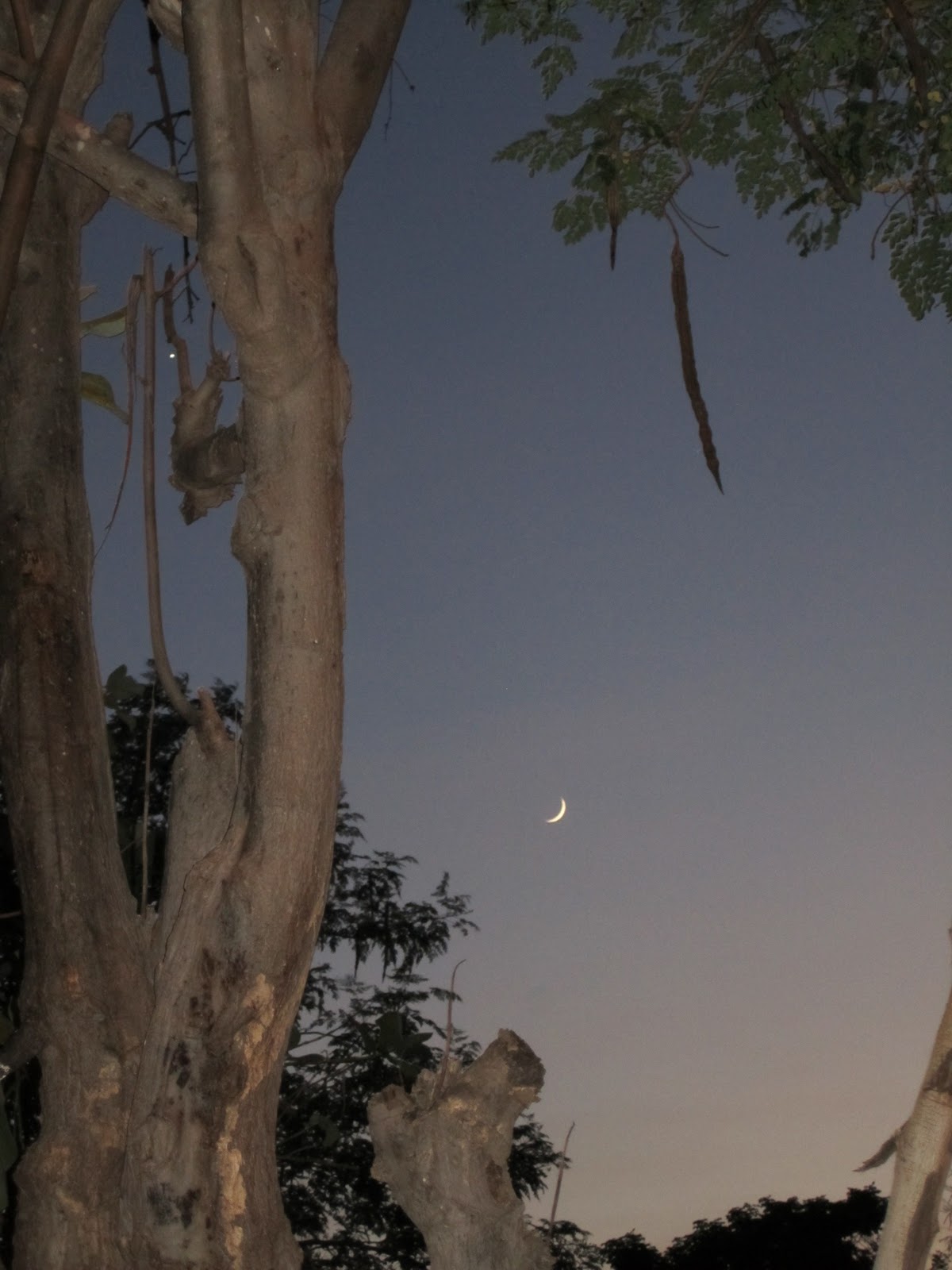
a glimpse of the new moon
 Korité Eve (09.Sep  2010)

We returned to our training villages on the afternoon of the Eve of Korité, although no one was actually sure whether or not Korité would be the next day yet.  This holiday marks the end of Ramadan and is as big and as much anticipated as Christmas.  The Marabou of each Muslim brotherhood* looks to the sky on the 28th day of Ramadan in search of a glimpse of the new moon.  This happens at sunset when people are breaking fast, hopefully for  the last time.  When and if he sees the moon, Korité is declared and is celebrated the next day.  Because each brotherhood’s Marabou declares Korité, however, the holiday sometimes falls on different days across Senegal, which apparently happened last year and caused all sorts of confusion and scheduling conflicts throughout the country.

This particular evening, however, the clouds had broken after a raining afternoon and the sky was fairly clear,  The streets and rooftops of my neighborhood were crowded with people searching the western sky for a sighting.  When they saw a sliver of the moon there was cheering, laughter, and dancing in the streets.  The kids acted as if they’d seen Santa Claus flying through the sky, which I guess, in their own way, they had.  Immediately thereafter, everyone rushed inside to watch Koranic television with interviews about the sighting and wise words from the Marabous about the end of Ramadan.


After dinner, my 12-yr old brother Cheikh, my 4-yr old sister Bébé Maty, and I rushed to the market to pick up a top that I was having altered for the big occasion.  The streets in the village were filled with people out celebrating and the town took on a new carnival-like vibe. I was immediately sorry we’d agreed to take the my little sister because I was afraid we’d lose her in the crowd.  The market in Thiès, earlier in the day, had been like this, too.  Everyone was out buying last minute things needed to make their holiday more festive, like gaudy hair extensions, shiny new shoes, and live chickens.  We made it safely to the tailor’s shop and waited for an hour while he filled the last of his Korité orders.  This is the busiest time of year for tailors as everyone--men, women, and little children alike--all get new clothes for the celebration, or so I was told.


Korité (10 Sept 2010)

I slept in the morning of Korité, since it was just the 2nd day since arriving in Senegal that I did not have any classes.  When I walked out of my room, I noticed Cheikh in a penned in area in our courtyard talking to his  “new pet chickens” that mysteriously arrived the day before.

OK FRIENDS…THIS IS WHERE THE WEAK AT HEART SHOULD TURN AWAY, OR AT LEAST SKIP DOWN TO THE NEXT CAPITALIZED SECTION THAT INDICATES IT’S SAFE TO COME BACK TO READING.

When I arrived back at my host-family’s house yesterday afternoon and noticed the presence of 3 chickens in our courtyard, I knew that they were not our new pets, but likely, very soon our celebratory dinner.  Having raised chickens myself, albeit only for eggs, and having seen the many chickens being carried around by their wing-pits for sale in the market the day before, I knew how this story would end.  So, as I was headed back to my room from the toilet, I stopped to watch Cheikh as he grabbed his first victim and reminded myself that I am not here in Senegal to change the customs of my hosts (a mantra I often repeat to myself.)  The killing was not exactly swift, but well-practiced.  Cheikh turn the hen on its side, stepped on it’s feet with one barefoot and it’s wings with the other and hung its head over a hole in the sandy earth he had dug just moments before.  Using a very dull knife (this is where the lack of swiftness comes in), he proceeded to cut the chicken’s throat and drain its blood into the hole.  As he grabbed the next one, the third chicken high-tailed it out of the pen.  Acting instinctively, I threw down the basket of toiletries I was holding and cornered the hen in the courtyard with my skirt to keep it from escaping.  Cheikh smiled proudly and came out to fetch his last victim, my dinner.
After this, my sister-in-law, Fatou, came out to take over from there.  AGAIN, IF YOU WANT TO BAIL OUT HERE, NOW’S YOUR SECOND CHANCE……I sat down next to her and we plucked, gutted, and cleaned chickens for about 2 hours.  First, she poured ladles full of hot water over the birds to loosen their feathers.  This was fairly effective and I’m sure made the job easier, but it was definitely labor-intensive, regardless.  Next, we held the chickens over a propane gas fire to burn off the really small hair-like feathers.  Then, using that same dull knife we cut open the carcasses and pulled out the insides.  We kept the livers, hearts, and stomachs (emptying these out of course) and through the rest in the bucket with the feathers and now-resident flies.  Next, we washed the birds, which I was beginning to fear would not be one of our steps.  Fatou stepped away to fetch her bar of soap (the very same one she uses to bath with.).  When she returned, she cut off pieces from a plastic mesh rice bag for each of us to use as scrub brushes and we soaped and scrubbed the birds until they were spic and span.

OK.  IT’S SAFE FOR ALL TO COME BACK NOW.


preparing the Korite meal


So the big meal of the day on Korité is lunch and we had this lovely chicken dish that I helped prepare.  We fried some chicken, and made pommes frites (French fries).  We then cut a couple of kilos of onions and marinated them in vinegar, oil, black pepper, and crushed Maggi and Dolci seasoning cubes (a necessary ingredient in all Senegalese dishes).  These were sautéed and it was all served together on a big platter and eaten with torn off pieces of baguettes.  Greasy, but good (and not Thieboudienne).


Cheikh sportin' his Grand Boubou
While we were cooking, my little brother donned his best grand bou-bou and went to the grande mosque to pray.  The rest of the day was kind of lazy, but we had a lot of visitors.  All of the men who’d been lounging around for the past month came out of the woodwork and stopped by in their bou-bous to say hello to the family.  Apparently, Korité is a holiday for making amends with your friends and neighbors and forgiving any bad blood between them.  I’m not sure how much of that went on today, since it was all conducted in Wolof.  In the early evening the young kids get dressed up and go door-to-door asking their neighbors for money.  So the holiday is kind of like Yom Kippor, Halloween, and Christmas all rolled into one.


The bedroom dinner hosts
So all day long, with the exception of my little brother who had gone to the mosque, everyone was wearing their everyday clothes.  The visitors all donned their new threads, but my family was still just hanging out in their regular house-work quality pagnes (wrap skirts). Later in the evening, Fatou and her husband (my uncle) Darou, who were married earlier in the year, got decked out to have some friends over for dinner.  Since families all live together, when just one couple wants to entertain, they do this in their bedrooms.  So Fatou and Darou had about eight people piled into their modest sized room with a tablecloth spread out on the queen-sized bed.  I suspect they were wearing the same clothes they’d been married in.  

 As the rest of the family sat down on the outdoor mat to eat a meal of left-over beans and bread from the evening before (as I mentioned, lunch is the big Korité meal), my family all encouraged me to go put on the outfit that I’d had made specially made for the occasion.  There was a lot of build-up to this at the Peace Corps training center and everyone had had clothes made.  Somehow, at this point, with the day almost over, all of the visitors having come and gone, and no one else in the family dressed for the occasion (aside from the entertaining newlyweds tucked away in their rooms), it seemed kind of pointless, so I politely declined and am saving my outfit for the next grand fête.

Site Selection

Just before heading back to our training villages for Korité, we all found out where our permanent site placements will be once we’re sworn in as Peace Corps Volunteers in mid-October.  As per tradition and despite the rain, we were all blind-folded and placed on a map of Senegal painted on the basketball court.  You could hear voices of the people who were standing near you before the blindfolds were removed--that was kind of fun. My site will be the city of Diourbel (pronounced jer-belle) and is a pretty big city (130,000 people) located just an hour and a half’s drive east of Thiès.  I’m taking over my site from someone who is signing on for a third year and will be moving to Thiès to work with our Cross-Cultural Coordinator, so she’ll be a nearby resource for me.

 
Oh where oh where will we go?
Looks like I'm going to Diourbel


The Sunday after Korité, I was able to spend 4 days visiting with her in Diourbel so she could show me the ropes, introduce me to potential work partners and meet my new host family.   We just arrived back from there today and I am happy with where I’ll be living and working for the next two years.  Because it’s about 3 hours inland from the coast the weather is hotter but I am living in Africa, so I should just suck it up and anticipate being hot for the duration.  Rumor has it that the winter months are much more tolerable, so there is some relief.  Diourbel is in the peanut basin so the soil is really sandy, as is just about everything I put in my mouth to eat.  The fine sand catches the wind and lands on everything so, invariably, you end up eating quite a bit of it.

My new host family is not the conventional Senegalese family, but I’m going to be quite happy there.  My host dad, Ibou, is in his early 60s, loves Jazz music and gardening, and will also be my work counter-part.  My host mom, Khady, is in her late 40s, is “trés chic et moderne”, and is a fabulous cook.  She owns the house where I will live and works part-time for Baol Enviornment, an organization that is also headquartered in the house.  Ibou is its President, Khady is its Treasurer.  The organization focuses on finding and implementing sustainable, eco-friendly solutions to development and community-minded activities.  They collaborate with all of the women’s groups in the Diourbel region to provide training and organizational stability.  They also work with micro-financers and local artisans to support environmentally-friendly project work.  It should be a cool to work with this group and I look forward to living with Ibou and Khady.  Their French is great and they seem like really down-to-earth people.
Ibou is very techie and loves new gadgets (note new camcorder in his hands)

The terrace garden / afternoon lounging area

Khady master of the double-fisted fan


There’s a lot of work already established in Diourbel that I can jump into after I get there and have finished my Peace Corp training.  I’m looking forward to working on these and finding some new projects, as well.  I’ve already lined up a French tutor so I can continue my language studies.  When we return to our training villages this weekend, I’ll be switching to Wolof lessons.  Wish me luck!
My new address is:
April Muñiz (Fatou N’Diaye)
B.P. 566
Diourbel, Senegal
West Africa  PAR AVION


List of  Fatous:

  • Fatou Sougou - name given to me by my host family in Tivaouane.  This is what people call my in the village.
  • Fatou Torré - my sweet midget aunt in Tivaouane where I'll continue living though mid-October
  • Fatou N’Dieye - my sister-in-law in Tivaoune
  • Fatou Sougou - deceased sister-in-law of my host-mother in Tivaouane and after whom I was named by my grandmother
  • Fatou Diop - nice lady who gives me my weekly allowance at the training center
  • Fatou N’Diaye - name given to me by my new host mother in Diourbel (freakish since she didn’t know my first host mother had named me Fatou).  This is what people will call me in Diourbel.  All future mail should include this name as well as my real name since that's what the Post Office will know me as.
  • Fatou N’Diaye - deceased sister of my host mother in Diourbel
  • Fatou Baldé - my new supervisor in Diourbel
  • Fatou Kebe - woman who owns a tailor shop that is interested in some business training
  • Fatou Mbacke Ngome - woman who owns a small food stand who is interested in some business training
  • Fatou Kane - Director of a school where I will be teaching basic accounting classes
So, basically every 10th person I meet, including me, is named Fatou.
More from me later...love to all!


Thursday, September 9, 2010

Les Toilettes et Le Mariage

Les Toilettes

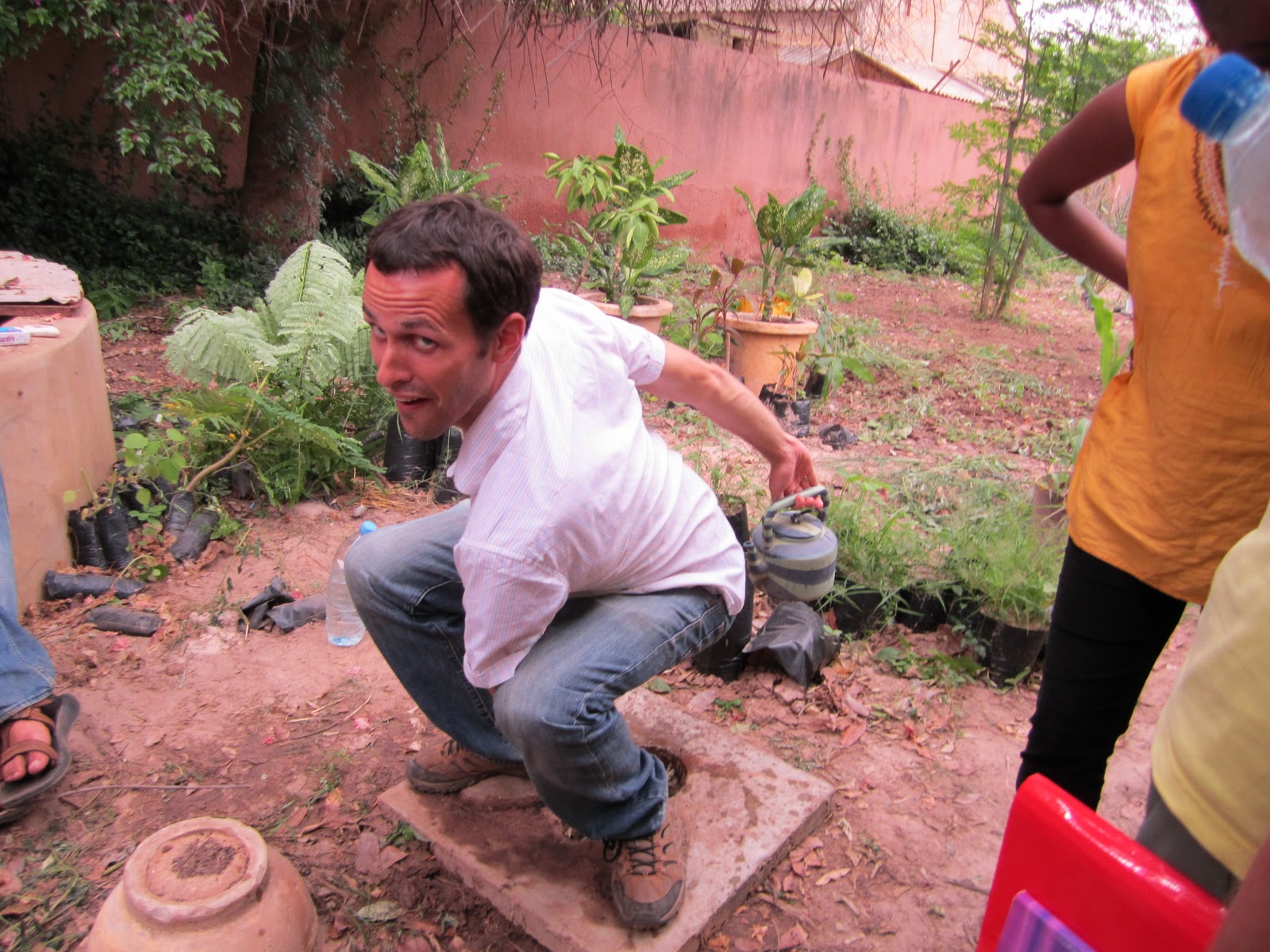
In case you’ve all been waiting on the edge of your seat for the aforementioned toilet edition, here it is.  First, let’s get the obvious out of the way, going to the bathroom in a third world country is not much fun and yet it’s still a necessary part of everyday life.  There are three types of basic toilets in Senegal:  1) the English toilet which, rumor has it, looks much like an American toilet, but is “flushed” using a bucket of water no doubt carried from some far-away water-source (I have yet to see one of these myself, so I’m trusting Peace Corps lore about its existence); 2) the Turkish toilet, which is a porcelain shallow bowl with tread on either side for one’s feet laid flush with the ground and has an elevated plumbed tank used for flushing (this is what we have at our training center in Thiès); and 3) the Senegalese toilet which, depending on where you live has the same shallow porcelain bowl as the Turkish toilet, or a simpler poured concrete version, but without the plumbing.  Basically, the latter is an indoor outhouse without an elevated seat and is what I have in my house.  The floor is tiled and slants towards the hole to make cleaning the room easier.  There is always a bucket of water next to the toilet to use for “flushing” and most people carry a small plastic tea kettle into the room with them for “wiping”; this is where the left hand comes into play.   The tea kettle is filled with water and held with the right hand while splashing water on and cleaning yourself with the left.  We actually received Peace Corps sanctioned training on this process.  I’m still opting to sneak toilet paper into the room with me.  Please don’t judge me.  It’s one little familiar way of life I’m choosing to hold on to (when I can) and also proves useful in swatting the flies away while I’m in there.

The toilet, in all it's glory.

Peace Corps toilet training.


My Batesville Bathroom.
To put things in perspective, I've added a photo of the bathroom renovation I had done at my home in Batesville just weeks before I left.  Ahh!  What I'd give for a soak in my clawfoot tub.

 Les Douches

Showering in Senegal also proves to be a challenging experience.  Basically, we take bucket baths, and because of the heat, we do this several times a day.  The “douche” is strikingly similar to the toilet in appearance:  basic hole in the ground, surrounded by tile slanted towards the drain, and a bucket of water sitting next to it.  My douche also contains a very suspect looking but extremely useful plastic box upon which one can sit while scrubbing up and rinsing off.  One bucket of water is generally enough for cleansing, shampooing, and even brushing one’s teeth.  I often share my bathing experience with a giant palmetto bug or two.  They enjoy rubbing their antennae together and making clicking sounds at me and, on occasion, are curious enough about what goes down the drain to run over, get real close, and check it out.
The shower with it's suspect "seat"


Mon petit voyeur

Fatou and the Bride (on right)
Le Mariage

Okay, so I feel the need to counterbalance this discussion of basic hygiene with a little socio-cultural lesson.  Last week, my fellow trainees and I were invited to attend une fête du mariage (a wedding party ) dans le quartier (in our neighborhood ).  My fellow trainee, Kelsey ,and I got decked out in our new complets (traditional and colorful two-piece dresses) and were accompanied by our classmates, Chris and Phil who picked us up at Keley’s host-family’s house where lots of pictures were taken, frighteningly reminiscent of prom-night.  The bride is a friend of Kelsey’s host-sister and her family had been involved in party preparation for days leading up to the event.  The wedding itself took place at the mosque next to my house earlier in the day and neither the bride or groom where present.  Apparently, this is common in Muslim weddings.  The Marabou and male congregation are joined by the parents of the bride and the parents of the groom to seal the deal and pray for the new couple.  Afterwards, a party for the bride is held at the bride’s parents house with only their friends, family, and neighbors.  When we arrived, we were introduced by the family as “the American delegation”, which amused us all.  The groom was nowhere to be found (also common) and, in fact, is not even due to come pick up his new bride for another two weeks, once Ramadan has ended.  The bride’s fête was a quiet affair, no music or dancing (also because of Ramadan) and was centered around having pictures taken with the bride and everyone breaking fast together.  We ate dates and beignets (little donut holes), drank coffee and ginger juice, and shared platters of chicken and onions.  Large mats where spread out on the sandy soil for all of the attendees (with the exception of the American delegation) to pray together, which was an impressive site.  We’ve been invited back to the official reception (where the groom will finally make an appearance) on September 18th.  This is when the husband comes to claim his wife and pay “le dot” (his dowry).  According to our teacher Sakhir, it can sometimes take a year or more for a husband to gather the money/gifts needed to claim his wife and/or to make proper accommodations at his family’s home for her and, until that time, they live apart. It’s a very rare occasion that a husband doesn’t bring his wife home to live with his family and for their children not to be raised there.  Because of this, and because polygamy is legal and common here, Senegalese households can get extremely large, sometimes 30-40 people all living together in a family compound.   I’ll save the topic of polygamy for another blog entry.


The American Delegation

The womenfolk at the wedding party


List of Vaccines Received to Live in Senegal:
  • Polio
  • Mumps/Measles Rubella
  • Yellow Fever
  • Typhoid
  • Meningistis
  • Rabies x 3
  • Hepititis A x 2
  • Hepititis B x 2
  • Flu/Swine Flu
  • Daily Malaria prophylaxis


Monday, August 23, 2010

The Real Senegal - What's behind the Peace Corps Gates


Back seat of the Sept-Place
On the way to Tivouane
Last Monday, after just 5 days at our Training Center in Thiès, we were released into the wild and sent to our first home-stay villages.  Thanks to a renewed
interest in the Peace Corps and a grant from USAID, we are the largest Peace Corps Training group that has been to Senegal, since it's work began here in 1963.  We total 64, of which 21 of us are in the Small Enterprise Development (SED) Group.  During our first few days at the training center, we were assessed and divided into small groups based on our language and technical abilities and then were sent to host-villages within an hours drive of Thiès for language and cultural immersion.  My group is small, just 3 other trainees and a Language/Cultural Facilitator.  We live in a medium size town, called Tivouane, just 24K north of Thiès.  To get there we took a Sept-Place, a beat-up old Peugeot taxi that holds 7 passenger + the driver.  I was dropped off at the door of the Touré home.  It’s taken me a full-week to figure out the structure of my host-family, which I will explain below, however, it became clear from the first moments I was there that my main family contact would be Cheikh Mbacké, my twelve year old “brother”, as he’s the only one in the family who speaks French with any confidence (and confidence he is not lacking!).   The rest of the family, all nine of them, speak only Wolof.  As the Sept-Place drove off with my colleagues and trainer, I felt as if I had been left on another planet.  Back at the Training Center, we were pretty isolated from our surroundings and, although in the company of folks we’d just met, we at least had a lot in common.  The Training Center was kind of like summer camp: shared rooms, group meals; scheduled classes; communal bathrooms, etc.  The home-stay experience was completely different.  We were suddenly plunged into an existing family structure, very clearly as outsiders who had no idea how to do even the simplest things.  We are like children once again.  I had to be shown how to use the toilet, how to bathe, how to eat, and how and where to sit down, and when we can leave the house.  The Peace Corps had done a pretty good job of preparing us for this culture change and our L/C Facilitator is in the same village to help and support us, but there’s nothing like just being plopped amidst a new family in a foreign land, where everything around you is different from the norm.

My family consists of 4 adult siblings, one wife, and 5 children.  Only one of the adults is male and he owns a “boutique” (a small metal shed on the side of the road that sells basic necessities, like small packets of margarine, sugar, and laundry detergent).  He’s at work most of his waking hours, but his wife is home with us and very much apart of our daily life.  The other adults are all sisters and unmarried.  The oldest of the sisters is a “little person” (I think that’s the PC word for munchkin, right?), so that’s different.  The next oldest is my “mother”, Bousou, who is just 3 years older than me.  She seems to take in all sorts of stray children, like Cheikh the orphaned son of her friend, and Arram, a neighborhood girl who works and also lives in the house.  The youngest of the siblings, who’s just 25 is in charge of caring for another sister’s two children while they are on break from school.

Bébé Maty

Seynabou and Arram sportin' their new bou-bous

My room in Tivouane


Since we're in the middle of Ramadan, home life for my family is a bit lazy.  Not eating or drinking all day in the African summer heat leads to a lot of napping.  This napping takes place on mats in the courtyard or on the vinyl-covered floor in the “napping room”.  This room is the only room, aside from my family's bedrooms  that contains furniture (like a real couch and chairs) but it is never used.  People just seem to go in there and lie on the floor, sometimes all of them at once.

Ramadan brings with it many other interesting daily activities including, loud chanting from a loudspeaker at the mosque outside my bedroom window from 4-5am, followed by the family getting up to eat breakfast before dawn.  People walk around at a snail’s pace because they’re refraining from eating or drinking from sunup to sundown and don’t want to exert too much energy.  The loudspeaker chanting also carries on at other specific times throughout the day, from cars with speakers strapped to their roofs.  There’s also a lot of spitting that goes on because apparently swallowing your own saliva counts as eating.  If for some reason you forget that it’s Ramadan and accidentally eat something, swallow large amounts of spit, and/or, Allah-forgive, vomit during the day (also strangely considered eating??--go figure) then you must pay this day back by fasting for an additional day after Ramadan has ended.

Finally, at about 7pm, the family breaks fast together and eats dates and bread with a thin layer of margarine and spicy tuna, and drinks café touba, which is a finely ground coffee containing cloves, cinnamon and about a pound of sugar.  This activity takes place as a group on a mat outside in the courtyard while watching TV:  first a Muslim prayer session, followed by a half hour Wolof comedy show, and then a really bad Indian soap opera dubbed in French.  Dinner is served at about 9pm on a big communal platter that usually consists of a layer of rice topped with a whole stewed fish and several vegetables in a yummy sauce.  Dinner varies slightly depending on how the rice is prepared and what type of sauce is used, but the vegetables stay the same from night to night:  eggplant, cabbage, carrot, okra, potato, manioc root, and radish.  We kneel on the ground around the platter and eat together.  There is grand protocol regarding eating here which was quite stressful for all the trainees until we’d done it enough to begin to feel comfortable.  We actually had Peace Corps training for this.  My "mother" tells me where at the platter to sit.  I’m not sure if I’m being place with regard to proximity to some specific food or to some person, so I usually wait for her to tell me.  Most of us eat with a large spoon,  but my “mother” and my “uncle’s” wife eat with their hand (just the right hand--never the left, but I’ll leave that to another blog entry devoted to toilet protocol.).  The women who eat with their hand ball up a small amount of rice with a piece of veggie or fish.  They, squeeze out the oil, and pop lick it off their hand.  Then they pick off bits of fish or veggies for others sitting at the platter and toss pieces into their eating area.  This is generally done for the young children and to me and is the equivalent of cutting up a child’s piece of meat for them.  Everyone has a designated eating area on the platter, basically the hand-sized space directly in front of them and it is impolite to reach into someone else’s area for a piece of food.  Instead, the big food pieces are tossed back to the center when people have taken off a small piece for themselves.  It’s important that the small piece is first placed on the platter in your eating area before you can pick it up and eat it.  Taking it straight from the center of the platter to your mouth is rude.  Burping loudly while eating, however, is not, and is it is common to hear a belch or two while we eat.  I try not to laugh at this, because no one else does.  Not to say that dinner isn’t fun.  There’s a lot of laughter that goes on, the joking is mostly in Wolof, and I think mostly directly at me, but I’ve learned to just laugh along with them.  Whatever the crazy-haired Toubac (common slang for white person) at the platter did probably was funny and I’ll learn why later.

My language and culture classes have been great.  It’s amazing how much we’re learned in just one week.  The Peace Corps really has an impressive adult-learning program and they have many Senegalese staff-members who’ve been working with them for 10+ years.  We have language class every morning from 9am - 1pm (or so), then break for lunch, napping, and homework until 4pm, then return for 2 ½ hours of cultural training.  Our classes are usually held at one of two of our host-family homes (the ones who have covered courtyards (aka shade), furniture, and space for us to gather.)   Our small class size is nice yet because we're usually in someone's home, we often are interrupted by someone’s little brother or sister who comes over to greet us (greeting is also worthy of it’s own blog entry, so more to come on that later).

We arrived back at the Training Center yesterday afternoon, after having been away a week, and it suddenly seemed so luxurious.  Chairs to sit on, cold water that has already been filtered, real showers, wi-fi, and fruit.  Many of the Agriculture trainees who are living in smaller villages had less protein then we SEDers did, so we were served a dinner of beef and beans to pump up our protein intake.  We also had fresh salad greens and veggies, which we’ve all begun to miss.  Before dinner, many of us ventured into town for a cold beer which was a great way to catch up with one another.

List of My Most Prized Possessions Thus Far:
  • Eventail (woven hand-held fan sold at the markets), used for swatting away flies and creating a small breeze during class
  • Oscillating fan, purchased with great fanfare (pun intended) over a 4-day period
  • French press and ground coffee brought from home, and enjoyed every morning “sans sucre”
  • Shower-to-Shower body powder (applied several times a day)
  • PC-supplied 3 gallon ceramic water filtration system
  • Mosquito repellent,  mosquito incense coils, mosquito net
  • French-English dictionary
  • Bar of anti-bacterial soap
  • Quick-dry camping towel
So happy about my new fan (and my water filter behind me on the left)

My "brother" Cheikh, who tirelessly helped procure my fan

    Friday, August 13, 2010

    Week Zero

    Thank you to the many wonderful friends and family members who joined me for my Bon Voyage Party and to Michael A., Krista, and Brett for planning and hosting it. I felt very loved and appreciated ;-) Also a big call out to Michael H. and Brynne who helped with the party prep and next day packing. You guys rocked!

    [This is where a picture of the party would be, but I managed to lose my camera there, so alas, no pictures.  After much searching for it, to no avail, my sweet Dad went out and bought me a new one for the trip.]

    Brett, Mom, Dad, and I finished our marathon house packing ordeal at 7pm on Sunday Aug 8th. Mom and Dad, although spent and exhausted, immediately got in the car to head back home and Brett and I took the last load to my storage unit and locked the door for the final time. Whew! Can't say I'm looking forward to opening that door upon my return.


    My empty house
    Wow, that's a lot of stuff!

    I drove to DC first thing Monday morning for our afternoon Staging event where I met the 63 other Peace Corps Trainees (PCTs) who would be joining me in Senegal. There, we got an introduction to what the weeks ahead would bring. Mom and Dad were able to join me for a final dinner that night and the Tuesday morning the group loaded up on two charter buses and headed over to the Dept. of Health and Human Services for Yellow Fever vaccinations and one last look at our nation's capital. From there we went straight to Dulles Airport and made it through check-in and security without issue.
    Goodbye Mr. President
    Unloading at Dulles
    Welcome to Senegal


    Our flight to Senegal was direct and took just under 8 hours. We arrived in Dakar before dawn and were met by our Country Director, a few PC staff members, and some very excited current Peace Corps Volunteers (PCVs) who had been so looking forward to our arrival that they woke up in the dark to meet us. We loaded up in land rovers and vans and made a two hour convoy to our training facility in Thiès, which is a gated compound filled with classrooms, dormitories, and various multipurpose huts.


    We were welcomed there by drummers and dancers who also double as our training facility staff. It was such a festive moment and quite an emotional experience after such a long journey. After a couple of hours of much-welcomed rest, we were served a tasty lunch in the traditional Senegalese manner, i.e., big round platters of food served atop mats on the floor around which 5 or 6 of us sit and eat with spoons. This first lunch consisted of fried rice with stewed beef, vegetables, and an amazingly flavorful sauce. Other foods we've enjoyed thus far include, seasoned pasta with grated cheese and a salad, herb-stuffed fish served atop fried rice and accompanied by root vegetables, bitter tomatoes, and cabbage smothered in a tamarind-based sauce, and garlic-grilled chicken and potatoes with shredded carrots, cucumbers, and mustard vinaigrette on the side. Not bad for African hut food, eh? All of the current PCVs attest to the fact that the food we'll experience outside of our training facility is equally amazing.

    The Lunch Hut
    Drummers
    Dancers


    According to our Training Director, this first week is referred to as Week Zero, as we don't get into the meat of our training until next week. Our first 5 days are filled with basic cross-culture orientation, language and skills evaluations, safety and health training, and vaccinations. On Monday we leave the compound and are assigned to home-stay families fairly close to Thiès, where we will receive the bulk of our language and cross-cultural training in small groups, returning periodically to the training center for group sessions. I'll be focusing on French training during this time and trying to get to an intermediate level by Week 10. Sounds like last summer's Spanish immersion all over again. If successful, I'll be inducted into the Peace Corps at the home of the US Ambassador on October 15th.


    Last night began the month of Ramandan, so 94% of the population will be fasting (no food nor water) between sunrise and sunset.  This will make our home-stay situation a little interesting, as our families will be making and serving us food while they're fasting.  Five times a day, we hear the call to pray from the nearby mosque--it's a haunting sound.  I look forward to learning more about this culture.

    Random things I learned today:
    • I will be adding bleach to my filtered water to keep from getting water-borne illnesses
    • Regardless of the bleach, I should expect to have diarrhea a lot during my 27 month stay here and should just get zen with that.
    • Walking around with a stick in your mouth (used for cleaning your teeth) is considered an object of beauty.
    • It costs just 23¢/min for anyone in the US to call my cell phone using Skype (in case you feel so inclined, my number is (221) 77 673 0064).
    • The median age of Senegalese people is 18.7 yrs old and the median age of my fellow PCTs is 24, needless to say, I'm feeling a bit, shall we say, “wise”.
    • Most cows have TB so raw milk is out of the question.
    • The current exchange rate is 1$US:512CFA (Senegalese African Franc).  To put the cost of things in perspective, it costs about 350CFA for a soda and about 100CFA for me to text you.
    • Although the mosquito net is effective in keeping mosquitoes out, it keeps all the steamy heat in, so sleeping has been a bit of a challenge.
    • First Letter From Home
    • Receiving letters will bring great joy, as evidenced by my new friend Garrison

    Wednesday, July 14, 2010

    Let the journey begin...

    My interest in the Peace Corps started in the early 1970's when my Godmother and her family moved to Kenya to begin their Peace Corps service. Letters and stories traveled across the Atlantic and piqued an early interest in the world around me. I've always enjoyed learning about new cultures and, throughout my life, have jumped at any opportunity to travel the globe. Now in mid-life, I find myself at a crossroads, having left one career and not yet ready to start the next. This seems like the perfect time to venture into the unknown, leave my comfort zone, and explore my innate capabilities.

    I leave August 9th (2010) for a one day training event in DC and then am off to Senegal on the 10th. For the first 10 weeks or so, I'll be living with a host family in the city of Thiès (pronounced Chess) and participating in training classes 6 days a week. Training will consist language courses (both French and Wolof), health and safety classes, and an overview of applicable business skills. After that, an evaluation will take place and with any luck I'll be inducted as a Peace Corps Volunteer and assigned a post in one of Senegal's 11 regions. My assignment will be in Small Enterprise Development or Eco-Tourism, both of which sound really exciting and challenging.

    For those who care to track my adventure and read about my experiences, check back often and/or sign up (below) to receive my posts by email.

    Embarking on this journey would not be possible without the support of my extended family and the encouragement of my friends. I am especially grateful to my parents who worked tirelessly the month before my departure to run needed errands and purchase miscellaneous necessities, to my dear friend Scot and his family who will be providing a caring home for my dogs while I'm gone, and to Brett, my partner and best friend, who has selflessly allowed me the time and space to venture forth to explore this unknown path. You all mean the world to me.