Showing posts with label ramadan. Show all posts

Tuesday, July 19, 2011

Mid-Service

It’s hard to believe that I’m at “mid-service” already.  In two weeks, I’ll have been in Senegal for an entire year. There have been weeks that have flown by and days that have dragged on, seemingly forever, but some years are like that for all of us, I suppose.  The difference, for me, has been that that everything in my world changed the moment I got off the plane in Dakar last August—the language, the culture, the food, the climate. I’m just going to say it, the whole experience has been a lot harder than I thought it would be. One year later, the languages are familiar, and although I can communicate with those around me, I’m far from fluent; the culture is less shocking, but still confusing and abrasive at times; the food has gone from interesting and new to commonplace and repetitive; and last but not least, it is still HOT.  Those of you on the East Coast have recently experienced the extreme of my daily temperatures.  I’m not sure anyone can every really get used to it.  Even the Senegalese who were born and raised here still include mention of the heat in their everyday conversation: “Dafa taang!” (It’s hot!) or “Taang nga?” (Aren’t you hot?).
At mid-service, there’s a changing of the guard or a passing of the baton, of sorts, that happens with volunteers.  Many of the folks who were here when we arrived have just ended their service and have gone home, moving my group up a notch in seniority, and new trainees have arrived taking our place as the new kids on the block.  It was difficult to say goodbye to the friends I’d made here over the past year.  Living in harsh conditions and sharing our experiences with one another creates a unique bond.  Much of what goes on over here is hard to explain to people not living in the midst of it. Part of me felt a little abandoned when a handful of my friends left a couple of weeks ago and it made the 12 months ahead of me feel a quite daunting.  At the same time, however, I was welcoming a new group of people who are just about to start their service and are so excited to be here.  They’re a good reminder of why I came and what I hope to accomplish before I leave.
July 2011 - Past, current, and future PCVs from the Dakar region.
This seems as good a time as any to take my first vacation.  Next week I’ll be meeting my parents in Barcelona for a Mediterranean cruise.  It may seem extreme to go from roughing it in a developing world to fancy living on the high seas, but I need it desperately, especially now at mid-service. A little booster will do me good and, hopefully, I’ll come back refreshed , ready to take on new projects , and motivated to push a little harder on some projects that have recently stalled. I timed this trip to coincide with Ramadan, as things here tend to slow down then.  Ninety-four percent of the country are Muslims and therefore Ramadan becomes all-consuming.  People fast (no food or water) from sunup until sundown (~5:30am ~7:30pm) which means things begin to slow down around lunchtime when people roll out their mats.  After that it’s hard to get much done.  Some volunteers show their solidarity and fast with their families, however, I've decided to spend this time recharging and regrouping. I’m totally at peace with that.  Sometimes you need to listen to what your body needs, like last week when I consumed 3 hard-boiled eggs, a bag of beef jerky, and a can of tuna, including its juice, within a 3 hour window.  Clearly, I needed a protein boost.  Other times you need to listen to your soul and mine is telling me I need to get away for a bit.  Hopefully, this vacation will leave both my body AND my soul a little more energized.
Truth be told, I’m a little bit worried how I’ll handle being in the developed world again.  I’m packing extra wraps because, even though I long to experience air conditioning again, I’m sure I’m going to freeze on the ship and then there are the socially questionable bad habits I’ve picked up since being here.  In order to integrate into a new culture you often find yourself doing what they do to try to fit in, but these don’t always translate into social norms in other parts of the world. The following is a list of 10 habits that I should probably try to break before getting on my plane next week:

  •  Burping during meals
  • Wiping my nose on the hem of my skirt
  • Flapping my arms like a chicken when I say “No”
  • Eating my meals on the floor
  • Wearing flip flops to formal events
  • Slurping my drinks
  • Scraping the filth beneath my fingernails with the page corners of the book I’m reading (ok, I admit, that one’s all me—no one reads here)
  • Adding “Inchallah” (God willing) to the end of every sentence
  • Letting insects crawl on my food while I’m eating
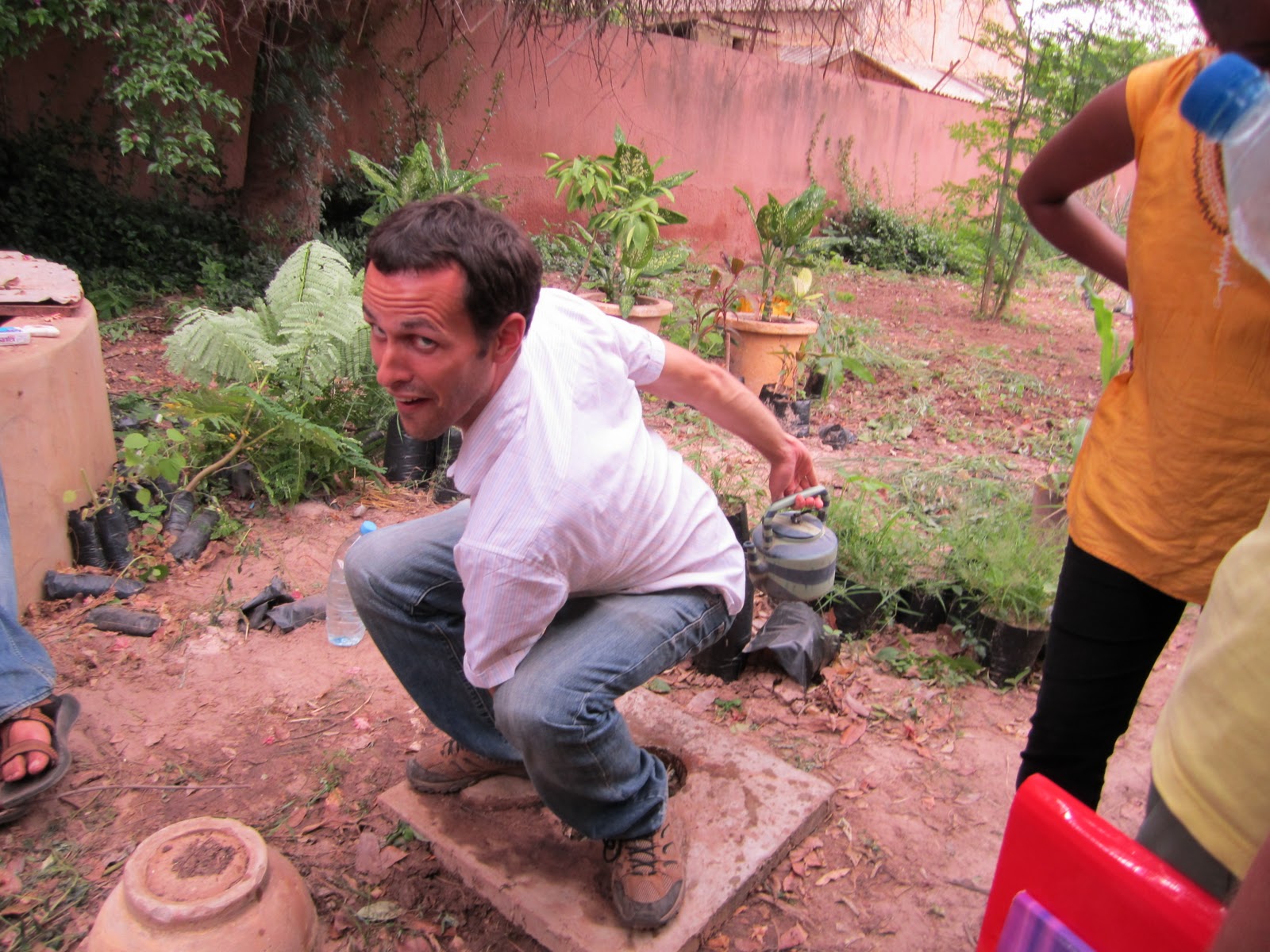
  • Squatting wherever and whenever when I need to pee
Wish me luck with all of that!


While I’m gone, the volunteers in my area will be continuing to raise money for a Girls Leadership Camp that we’ve planned for the end of September. We’ve been working hard these past few months to coordinate this project.  I’ve even been in discussions with NPR’s West African Correspondent, Ofeibea Quist-Arcton, to join our Career Day panel.  Per Peace Corps policy, all funding for camps must be come through a Peace Corps Partnership Grant, which basically means that we have to solicit funding from people back home.  So, if you’ve been looking for a way to support some of the work I’m doing over here, this would be your opportunity.  One of the goals of this camp is to encourage girls with aptitude to continue their education, as this is a problem in Senegal.  According to a recent gender assessment study done by USAID, the ratio of girls to boys drops from 98% in primary school, to 80% in middle school, and then to only 54% in high school.  Girls are usually pulled out of school early to assist with household chores or later to get married.  Our camp will focus on the importance of continuing their education, on the roles they can play in their society, and the opportunities that are available to them.  We’ve got about 40 girls who are coming to camp, which is being held at a local university not far from my town.  To donate to this project, follow this link:  Thiès Region Girls Leadership Camp 2011.

Also, when you get a chance, take a look at the new tabs I’ve added to the top of my blog—Photos, Videos, and Sounds.  These should provide another window into my world here.  I’ll be updating these over the next year as I continue my service.

Thursday, September 9, 2010

Les Toilettes et Le Mariage

Les Toilettes

In case you’ve all been waiting on the edge of your seat for the aforementioned toilet edition, here it is.  First, let’s get the obvious out of the way, going to the bathroom in a third world country is not much fun and yet it’s still a necessary part of everyday life.  There are three types of basic toilets in Senegal:  1) the English toilet which, rumor has it, looks much like an American toilet, but is “flushed” using a bucket of water no doubt carried from some far-away water-source (I have yet to see one of these myself, so I’m trusting Peace Corps lore about its existence); 2) the Turkish toilet, which is a porcelain shallow bowl with tread on either side for one’s feet laid flush with the ground and has an elevated plumbed tank used for flushing (this is what we have at our training center in Thiès); and 3) the Senegalese toilet which, depending on where you live has the same shallow porcelain bowl as the Turkish toilet, or a simpler poured concrete version, but without the plumbing.  Basically, the latter is an indoor outhouse without an elevated seat and is what I have in my house.  The floor is tiled and slants towards the hole to make cleaning the room easier.  There is always a bucket of water next to the toilet to use for “flushing” and most people carry a small plastic tea kettle into the room with them for “wiping”; this is where the left hand comes into play.   The tea kettle is filled with water and held with the right hand while splashing water on and cleaning yourself with the left.  We actually received Peace Corps sanctioned training on this process.  I’m still opting to sneak toilet paper into the room with me.  Please don’t judge me.  It’s one little familiar way of life I’m choosing to hold on to (when I can) and also proves useful in swatting the flies away while I’m in there.

The toilet, in all it's glory.

Peace Corps toilet training.


My Batesville Bathroom.
To put things in perspective, I've added a photo of the bathroom renovation I had done at my home in Batesville just weeks before I left.  Ahh!  What I'd give for a soak in my clawfoot tub.

 Les Douches

Showering in Senegal also proves to be a challenging experience.  Basically, we take bucket baths, and because of the heat, we do this several times a day.  The “douche” is strikingly similar to the toilet in appearance:  basic hole in the ground, surrounded by tile slanted towards the drain, and a bucket of water sitting next to it.  My douche also contains a very suspect looking but extremely useful plastic box upon which one can sit while scrubbing up and rinsing off.  One bucket of water is generally enough for cleansing, shampooing, and even brushing one’s teeth.  I often share my bathing experience with a giant palmetto bug or two.  They enjoy rubbing their antennae together and making clicking sounds at me and, on occasion, are curious enough about what goes down the drain to run over, get real close, and check it out.
The shower with it's suspect "seat"


Mon petit voyeur

Fatou and the Bride (on right)
Le Mariage

Okay, so I feel the need to counterbalance this discussion of basic hygiene with a little socio-cultural lesson.  Last week, my fellow trainees and I were invited to attend une fête du mariage (a wedding party ) dans le quartier (in our neighborhood ).  My fellow trainee, Kelsey ,and I got decked out in our new complets (traditional and colorful two-piece dresses) and were accompanied by our classmates, Chris and Phil who picked us up at Keley’s host-family’s house where lots of pictures were taken, frighteningly reminiscent of prom-night.  The bride is a friend of Kelsey’s host-sister and her family had been involved in party preparation for days leading up to the event.  The wedding itself took place at the mosque next to my house earlier in the day and neither the bride or groom where present.  Apparently, this is common in Muslim weddings.  The Marabou and male congregation are joined by the parents of the bride and the parents of the groom to seal the deal and pray for the new couple.  Afterwards, a party for the bride is held at the bride’s parents house with only their friends, family, and neighbors.  When we arrived, we were introduced by the family as “the American delegation”, which amused us all.  The groom was nowhere to be found (also common) and, in fact, is not even due to come pick up his new bride for another two weeks, once Ramadan has ended.  The bride’s fête was a quiet affair, no music or dancing (also because of Ramadan) and was centered around having pictures taken with the bride and everyone breaking fast together.  We ate dates and beignets (little donut holes), drank coffee and ginger juice, and shared platters of chicken and onions.  Large mats where spread out on the sandy soil for all of the attendees (with the exception of the American delegation) to pray together, which was an impressive site.  We’ve been invited back to the official reception (where the groom will finally make an appearance) on September 18th.  This is when the husband comes to claim his wife and pay “le dot” (his dowry).  According to our teacher Sakhir, it can sometimes take a year or more for a husband to gather the money/gifts needed to claim his wife and/or to make proper accommodations at his family’s home for her and, until that time, they live apart. It’s a very rare occasion that a husband doesn’t bring his wife home to live with his family and for their children not to be raised there.  Because of this, and because polygamy is legal and common here, Senegalese households can get extremely large, sometimes 30-40 people all living together in a family compound.   I’ll save the topic of polygamy for another blog entry.


The American Delegation

The womenfolk at the wedding party


List of Vaccines Received to Live in Senegal:
  • Polio
  • Mumps/Measles Rubella
  • Yellow Fever
  • Typhoid
  • Meningistis
  • Rabies x 3
  • Hepititis A x 2
  • Hepititis B x 2
  • Flu/Swine Flu
  • Daily Malaria prophylaxis


Monday, August 23, 2010

The Real Senegal - What's behind the Peace Corps Gates


Back seat of the Sept-Place
On the way to Tivouane
Last Monday, after just 5 days at our Training Center in Thiès, we were released into the wild and sent to our first home-stay villages.  Thanks to a renewed
interest in the Peace Corps and a grant from USAID, we are the largest Peace Corps Training group that has been to Senegal, since it's work began here in 1963.  We total 64, of which 21 of us are in the Small Enterprise Development (SED) Group.  During our first few days at the training center, we were assessed and divided into small groups based on our language and technical abilities and then were sent to host-villages within an hours drive of Thiès for language and cultural immersion.  My group is small, just 3 other trainees and a Language/Cultural Facilitator.  We live in a medium size town, called Tivouane, just 24K north of Thiès.  To get there we took a Sept-Place, a beat-up old Peugeot taxi that holds 7 passenger + the driver.  I was dropped off at the door of the Touré home.  It’s taken me a full-week to figure out the structure of my host-family, which I will explain below, however, it became clear from the first moments I was there that my main family contact would be Cheikh Mbacké, my twelve year old “brother”, as he’s the only one in the family who speaks French with any confidence (and confidence he is not lacking!).   The rest of the family, all nine of them, speak only Wolof.  As the Sept-Place drove off with my colleagues and trainer, I felt as if I had been left on another planet.  Back at the Training Center, we were pretty isolated from our surroundings and, although in the company of folks we’d just met, we at least had a lot in common.  The Training Center was kind of like summer camp: shared rooms, group meals; scheduled classes; communal bathrooms, etc.  The home-stay experience was completely different.  We were suddenly plunged into an existing family structure, very clearly as outsiders who had no idea how to do even the simplest things.  We are like children once again.  I had to be shown how to use the toilet, how to bathe, how to eat, and how and where to sit down, and when we can leave the house.  The Peace Corps had done a pretty good job of preparing us for this culture change and our L/C Facilitator is in the same village to help and support us, but there’s nothing like just being plopped amidst a new family in a foreign land, where everything around you is different from the norm.

My family consists of 4 adult siblings, one wife, and 5 children.  Only one of the adults is male and he owns a “boutique” (a small metal shed on the side of the road that sells basic necessities, like small packets of margarine, sugar, and laundry detergent).  He’s at work most of his waking hours, but his wife is home with us and very much apart of our daily life.  The other adults are all sisters and unmarried.  The oldest of the sisters is a “little person” (I think that’s the PC word for munchkin, right?), so that’s different.  The next oldest is my “mother”, Bousou, who is just 3 years older than me.  She seems to take in all sorts of stray children, like Cheikh the orphaned son of her friend, and Arram, a neighborhood girl who works and also lives in the house.  The youngest of the siblings, who’s just 25 is in charge of caring for another sister’s two children while they are on break from school.

Bébé Maty

Seynabou and Arram sportin' their new bou-bous

My room in Tivouane


Since we're in the middle of Ramadan, home life for my family is a bit lazy.  Not eating or drinking all day in the African summer heat leads to a lot of napping.  This napping takes place on mats in the courtyard or on the vinyl-covered floor in the “napping room”.  This room is the only room, aside from my family's bedrooms  that contains furniture (like a real couch and chairs) but it is never used.  People just seem to go in there and lie on the floor, sometimes all of them at once.

Ramadan brings with it many other interesting daily activities including, loud chanting from a loudspeaker at the mosque outside my bedroom window from 4-5am, followed by the family getting up to eat breakfast before dawn.  People walk around at a snail’s pace because they’re refraining from eating or drinking from sunup to sundown and don’t want to exert too much energy.  The loudspeaker chanting also carries on at other specific times throughout the day, from cars with speakers strapped to their roofs.  There’s also a lot of spitting that goes on because apparently swallowing your own saliva counts as eating.  If for some reason you forget that it’s Ramadan and accidentally eat something, swallow large amounts of spit, and/or, Allah-forgive, vomit during the day (also strangely considered eating??--go figure) then you must pay this day back by fasting for an additional day after Ramadan has ended.

Finally, at about 7pm, the family breaks fast together and eats dates and bread with a thin layer of margarine and spicy tuna, and drinks café touba, which is a finely ground coffee containing cloves, cinnamon and about a pound of sugar.  This activity takes place as a group on a mat outside in the courtyard while watching TV:  first a Muslim prayer session, followed by a half hour Wolof comedy show, and then a really bad Indian soap opera dubbed in French.  Dinner is served at about 9pm on a big communal platter that usually consists of a layer of rice topped with a whole stewed fish and several vegetables in a yummy sauce.  Dinner varies slightly depending on how the rice is prepared and what type of sauce is used, but the vegetables stay the same from night to night:  eggplant, cabbage, carrot, okra, potato, manioc root, and radish.  We kneel on the ground around the platter and eat together.  There is grand protocol regarding eating here which was quite stressful for all the trainees until we’d done it enough to begin to feel comfortable.  We actually had Peace Corps training for this.  My "mother" tells me where at the platter to sit.  I’m not sure if I’m being place with regard to proximity to some specific food or to some person, so I usually wait for her to tell me.  Most of us eat with a large spoon,  but my “mother” and my “uncle’s” wife eat with their hand (just the right hand--never the left, but I’ll leave that to another blog entry devoted to toilet protocol.).  The women who eat with their hand ball up a small amount of rice with a piece of veggie or fish.  They, squeeze out the oil, and pop lick it off their hand.  Then they pick off bits of fish or veggies for others sitting at the platter and toss pieces into their eating area.  This is generally done for the young children and to me and is the equivalent of cutting up a child’s piece of meat for them.  Everyone has a designated eating area on the platter, basically the hand-sized space directly in front of them and it is impolite to reach into someone else’s area for a piece of food.  Instead, the big food pieces are tossed back to the center when people have taken off a small piece for themselves.  It’s important that the small piece is first placed on the platter in your eating area before you can pick it up and eat it.  Taking it straight from the center of the platter to your mouth is rude.  Burping loudly while eating, however, is not, and is it is common to hear a belch or two while we eat.  I try not to laugh at this, because no one else does.  Not to say that dinner isn’t fun.  There’s a lot of laughter that goes on, the joking is mostly in Wolof, and I think mostly directly at me, but I’ve learned to just laugh along with them.  Whatever the crazy-haired Toubac (common slang for white person) at the platter did probably was funny and I’ll learn why later.

My language and culture classes have been great.  It’s amazing how much we’re learned in just one week.  The Peace Corps really has an impressive adult-learning program and they have many Senegalese staff-members who’ve been working with them for 10+ years.  We have language class every morning from 9am - 1pm (or so), then break for lunch, napping, and homework until 4pm, then return for 2 ½ hours of cultural training.  Our classes are usually held at one of two of our host-family homes (the ones who have covered courtyards (aka shade), furniture, and space for us to gather.)   Our small class size is nice yet because we're usually in someone's home, we often are interrupted by someone’s little brother or sister who comes over to greet us (greeting is also worthy of it’s own blog entry, so more to come on that later).

We arrived back at the Training Center yesterday afternoon, after having been away a week, and it suddenly seemed so luxurious.  Chairs to sit on, cold water that has already been filtered, real showers, wi-fi, and fruit.  Many of the Agriculture trainees who are living in smaller villages had less protein then we SEDers did, so we were served a dinner of beef and beans to pump up our protein intake.  We also had fresh salad greens and veggies, which we’ve all begun to miss.  Before dinner, many of us ventured into town for a cold beer which was a great way to catch up with one another.

List of My Most Prized Possessions Thus Far:
  • Eventail (woven hand-held fan sold at the markets), used for swatting away flies and creating a small breeze during class
  • Oscillating fan, purchased with great fanfare (pun intended) over a 4-day period
  • French press and ground coffee brought from home, and enjoyed every morning “sans sucre”
  • Shower-to-Shower body powder (applied several times a day)
  • PC-supplied 3 gallon ceramic water filtration system
  • Mosquito repellent,  mosquito incense coils, mosquito net
  • French-English dictionary
  • Bar of anti-bacterial soap
  • Quick-dry camping towel
So happy about my new fan (and my water filter behind me on the left)

My "brother" Cheikh, who tirelessly helped procure my fan

    Friday, August 13, 2010

    Week Zero

    Thank you to the many wonderful friends and family members who joined me for my Bon Voyage Party and to Michael A., Krista, and Brett for planning and hosting it. I felt very loved and appreciated ;-) Also a big call out to Michael H. and Brynne who helped with the party prep and next day packing. You guys rocked!

    [This is where a picture of the party would be, but I managed to lose my camera there, so alas, no pictures.  After much searching for it, to no avail, my sweet Dad went out and bought me a new one for the trip.]

    Brett, Mom, Dad, and I finished our marathon house packing ordeal at 7pm on Sunday Aug 8th. Mom and Dad, although spent and exhausted, immediately got in the car to head back home and Brett and I took the last load to my storage unit and locked the door for the final time. Whew! Can't say I'm looking forward to opening that door upon my return.


    My empty house
    Wow, that's a lot of stuff!

    I drove to DC first thing Monday morning for our afternoon Staging event where I met the 63 other Peace Corps Trainees (PCTs) who would be joining me in Senegal. There, we got an introduction to what the weeks ahead would bring. Mom and Dad were able to join me for a final dinner that night and the Tuesday morning the group loaded up on two charter buses and headed over to the Dept. of Health and Human Services for Yellow Fever vaccinations and one last look at our nation's capital. From there we went straight to Dulles Airport and made it through check-in and security without issue.
    Goodbye Mr. President
    Unloading at Dulles
    Welcome to Senegal


    Our flight to Senegal was direct and took just under 8 hours. We arrived in Dakar before dawn and were met by our Country Director, a few PC staff members, and some very excited current Peace Corps Volunteers (PCVs) who had been so looking forward to our arrival that they woke up in the dark to meet us. We loaded up in land rovers and vans and made a two hour convoy to our training facility in Thiès, which is a gated compound filled with classrooms, dormitories, and various multipurpose huts.


    We were welcomed there by drummers and dancers who also double as our training facility staff. It was such a festive moment and quite an emotional experience after such a long journey. After a couple of hours of much-welcomed rest, we were served a tasty lunch in the traditional Senegalese manner, i.e., big round platters of food served atop mats on the floor around which 5 or 6 of us sit and eat with spoons. This first lunch consisted of fried rice with stewed beef, vegetables, and an amazingly flavorful sauce. Other foods we've enjoyed thus far include, seasoned pasta with grated cheese and a salad, herb-stuffed fish served atop fried rice and accompanied by root vegetables, bitter tomatoes, and cabbage smothered in a tamarind-based sauce, and garlic-grilled chicken and potatoes with shredded carrots, cucumbers, and mustard vinaigrette on the side. Not bad for African hut food, eh? All of the current PCVs attest to the fact that the food we'll experience outside of our training facility is equally amazing.

    The Lunch Hut
    Drummers
    Dancers


    According to our Training Director, this first week is referred to as Week Zero, as we don't get into the meat of our training until next week. Our first 5 days are filled with basic cross-culture orientation, language and skills evaluations, safety and health training, and vaccinations. On Monday we leave the compound and are assigned to home-stay families fairly close to Thiès, where we will receive the bulk of our language and cross-cultural training in small groups, returning periodically to the training center for group sessions. I'll be focusing on French training during this time and trying to get to an intermediate level by Week 10. Sounds like last summer's Spanish immersion all over again. If successful, I'll be inducted into the Peace Corps at the home of the US Ambassador on October 15th.


    Last night began the month of Ramandan, so 94% of the population will be fasting (no food nor water) between sunrise and sunset.  This will make our home-stay situation a little interesting, as our families will be making and serving us food while they're fasting.  Five times a day, we hear the call to pray from the nearby mosque--it's a haunting sound.  I look forward to learning more about this culture.

    Random things I learned today:
    • I will be adding bleach to my filtered water to keep from getting water-borne illnesses
    • Regardless of the bleach, I should expect to have diarrhea a lot during my 27 month stay here and should just get zen with that.
    • Walking around with a stick in your mouth (used for cleaning your teeth) is considered an object of beauty.
    • It costs just 23¢/min for anyone in the US to call my cell phone using Skype (in case you feel so inclined, my number is (221) 77 673 0064).
    • The median age of Senegalese people is 18.7 yrs old and the median age of my fellow PCTs is 24, needless to say, I'm feeling a bit, shall we say, “wise”.
    • Most cows have TB so raw milk is out of the question.
    • The current exchange rate is 1$US:512CFA (Senegalese African Franc).  To put the cost of things in perspective, it costs about 350CFA for a soda and about 100CFA for me to text you.
    • Although the mosquito net is effective in keeping mosquitoes out, it keeps all the steamy heat in, so sleeping has been a bit of a challenge.
    • First Letter From Home
    • Receiving letters will bring great joy, as evidenced by my new friend Garrison