Showing posts with label ofeibea quist-archton. Show all posts

Tuesday, July 19, 2011

Mid-Service

It’s hard to believe that I’m at “mid-service” already.  In two weeks, I’ll have been in Senegal for an entire year. There have been weeks that have flown by and days that have dragged on, seemingly forever, but some years are like that for all of us, I suppose.  The difference, for me, has been that that everything in my world changed the moment I got off the plane in Dakar last August—the language, the culture, the food, the climate. I’m just going to say it, the whole experience has been a lot harder than I thought it would be. One year later, the languages are familiar, and although I can communicate with those around me, I’m far from fluent; the culture is less shocking, but still confusing and abrasive at times; the food has gone from interesting and new to commonplace and repetitive; and last but not least, it is still HOT.  Those of you on the East Coast have recently experienced the extreme of my daily temperatures.  I’m not sure anyone can every really get used to it.  Even the Senegalese who were born and raised here still include mention of the heat in their everyday conversation: “Dafa taang!” (It’s hot!) or “Taang nga?” (Aren’t you hot?).
At mid-service, there’s a changing of the guard or a passing of the baton, of sorts, that happens with volunteers.  Many of the folks who were here when we arrived have just ended their service and have gone home, moving my group up a notch in seniority, and new trainees have arrived taking our place as the new kids on the block.  It was difficult to say goodbye to the friends I’d made here over the past year.  Living in harsh conditions and sharing our experiences with one another creates a unique bond.  Much of what goes on over here is hard to explain to people not living in the midst of it. Part of me felt a little abandoned when a handful of my friends left a couple of weeks ago and it made the 12 months ahead of me feel a quite daunting.  At the same time, however, I was welcoming a new group of people who are just about to start their service and are so excited to be here.  They’re a good reminder of why I came and what I hope to accomplish before I leave.
July 2011 - Past, current, and future PCVs from the Dakar region.
This seems as good a time as any to take my first vacation.  Next week I’ll be meeting my parents in Barcelona for a Mediterranean cruise.  It may seem extreme to go from roughing it in a developing world to fancy living on the high seas, but I need it desperately, especially now at mid-service. A little booster will do me good and, hopefully, I’ll come back refreshed , ready to take on new projects , and motivated to push a little harder on some projects that have recently stalled. I timed this trip to coincide with Ramadan, as things here tend to slow down then.  Ninety-four percent of the country are Muslims and therefore Ramadan becomes all-consuming.  People fast (no food or water) from sunup until sundown (~5:30am ~7:30pm) which means things begin to slow down around lunchtime when people roll out their mats.  After that it’s hard to get much done.  Some volunteers show their solidarity and fast with their families, however, I've decided to spend this time recharging and regrouping. I’m totally at peace with that.  Sometimes you need to listen to what your body needs, like last week when I consumed 3 hard-boiled eggs, a bag of beef jerky, and a can of tuna, including its juice, within a 3 hour window.  Clearly, I needed a protein boost.  Other times you need to listen to your soul and mine is telling me I need to get away for a bit.  Hopefully, this vacation will leave both my body AND my soul a little more energized.
Truth be told, I’m a little bit worried how I’ll handle being in the developed world again.  I’m packing extra wraps because, even though I long to experience air conditioning again, I’m sure I’m going to freeze on the ship and then there are the socially questionable bad habits I’ve picked up since being here.  In order to integrate into a new culture you often find yourself doing what they do to try to fit in, but these don’t always translate into social norms in other parts of the world. The following is a list of 10 habits that I should probably try to break before getting on my plane next week:

  •  Burping during meals
  • Wiping my nose on the hem of my skirt
  • Flapping my arms like a chicken when I say “No”
  • Eating my meals on the floor
  • Wearing flip flops to formal events
  • Slurping my drinks
  • Scraping the filth beneath my fingernails with the page corners of the book I’m reading (ok, I admit, that one’s all me—no one reads here)
  • Adding “Inchallah” (God willing) to the end of every sentence
  • Letting insects crawl on my food while I’m eating
  • Squatting wherever and whenever when I need to pee
Wish me luck with all of that!


While I’m gone, the volunteers in my area will be continuing to raise money for a Girls Leadership Camp that we’ve planned for the end of September. We’ve been working hard these past few months to coordinate this project.  I’ve even been in discussions with NPR’s West African Correspondent, Ofeibea Quist-Arcton, to join our Career Day panel.  Per Peace Corps policy, all funding for camps must be come through a Peace Corps Partnership Grant, which basically means that we have to solicit funding from people back home.  So, if you’ve been looking for a way to support some of the work I’m doing over here, this would be your opportunity.  One of the goals of this camp is to encourage girls with aptitude to continue their education, as this is a problem in Senegal.  According to a recent gender assessment study done by USAID, the ratio of girls to boys drops from 98% in primary school, to 80% in middle school, and then to only 54% in high school.  Girls are usually pulled out of school early to assist with household chores or later to get married.  Our camp will focus on the importance of continuing their education, on the roles they can play in their society, and the opportunities that are available to them.  We’ve got about 40 girls who are coming to camp, which is being held at a local university not far from my town.  To donate to this project, follow this link:  Thiès Region Girls Leadership Camp 2011.

Also, when you get a chance, take a look at the new tabs I’ve added to the top of my blog—Photos, Videos, and Sounds.  These should provide another window into my world here.  I’ll be updating these over the next year as I continue my service.

Tuesday, October 26, 2010

Dakar and Diourbel


Dakar - The Big City

Until I arrived in Senegal, all I knew about Dakar was that Ofeibea Quist-Arcton, NPR’s West African foreign correspondent reports from there and  signs off on all of her stories with a melodic pronunciation of the city’s name.  Aside from that and a quick turnaround at the Leopold Senghor International Airport before the crack of dawn the day we arrived, Dakar and all it had to offer was a big mystery to me.  It was reportedly, the land of plenty.  Whenever anyone asked “can you get X or Y in Senegal”, referring to some creature comfort from home that someone failed to bring with them, the answer was always “yes, you can get that in Dakar”  We’d also learned that getting in and out of Dakar was a traffic nightmare.  Situated just 70 km (44 miles) from Thiès, it often took our trainers 2-3 hours to commute.

October 4th was Dakar Day according to our training calendar.  Early that morning, we loaded up in Peace Corps buses and headed into the city.  On the outskirts of town, we stopped along the side of the road to transfer some passengers; those folks that had fallen ill (a weekly occurrence during our training period) were shuttled in another vehicle and sent directly to the Med Hut (the medical facility in the Peace Corps Senegal office) and several 3rd year Volunteers who are now living in Dakar jumped on board our buses to give us a guided tour of the city.  Their commentary went something like this,
  1.  “Don’t come to this section of town or you’ll surely get mugged.”
  2. “If you want to by a sheep or cow, this is the place to do it, but get here early for the good ones.”
  3. “On Saturdays, this street is lined with used clothing for sale; you can pick up ratty old clothes donated to a charitable organization in the US and sent over here in a shipping container, however if you have the patience to pick through it you might just find something really cool.”
  4. “This is the stadium where the big football (soccer) matches are held, but we’re not allowed attend them anymore because last year there was a huge riot and several volunteers had to be rescued from the crowd by the Gendarmerie (the National Guard) after trying to flee the attacking crowd in a taxi and running over and killing someone."
  5. “Here’s a cool club where we go out dancing the first Saturday of every month and stay up until all hours of the morning”.  
Oddly, all of this sage guidance was said with the same tone of voice, as if each statement carried equal importance.  Ahh, the perspective of youth.


Our guides were quick to point out Chez Ass


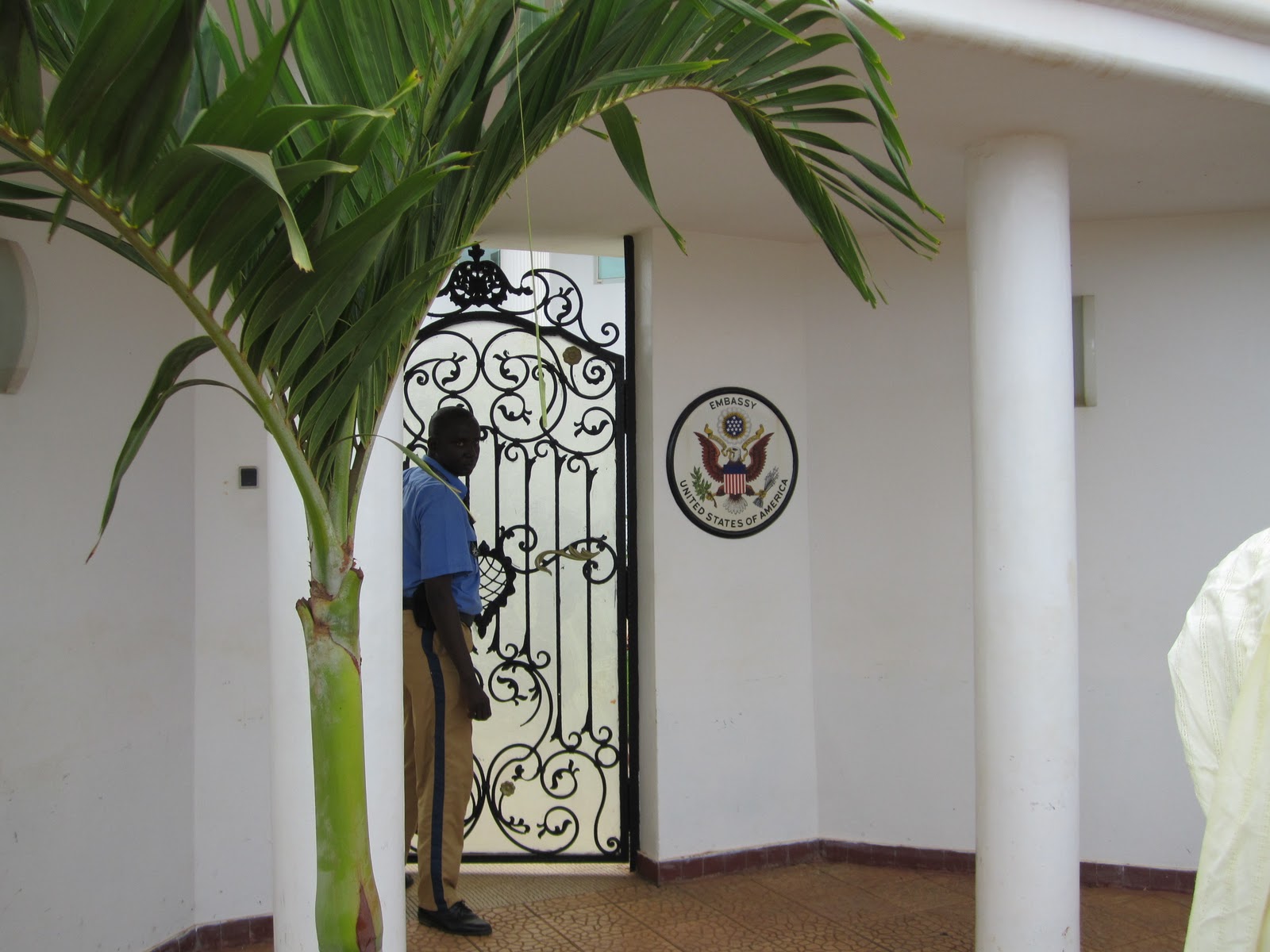
After the bus tour, we parked our vehicles within the US Embassy gates and split  up into groups to tour the downtown area.  The streets were bustling with modern cars, businessmen headed to appointments, and people enjoying food and drinks at sidewalk cafés.  Tall modern buildings lined the avenues and fountains sat inside traffic circles.  It was trés moderne and reminded me of European cities I’d visited in the past.  Having spent 7 weeks at this point in interior Senegalese towns and villages, it was hard to believe we were in the same country.

A bustling city street in Dakar

A fountain in the traffic circle


From there we drove along the Corniche, the wide boulevard that parallels the coastline, and were also warned to stay away from its wide sidewalks after dark to avoid running into bandits that prey on Westerners.  After passing the recently unveiled African Renaissance Monument, we soon arrived at Club Altantique, otherwise known as the American Club.  It’s a small country club of sorts that caters to American ex-pats and their families but waives the annual membership fee for us poor Peace Corps volunteers.  It has a pool, snack shack, volleyball court, bar, and themed dinner nights and serves as a nice oasis of familiarity where we can go when we’re in the area (without fear of bandits, muggers, or overpriced second-hand clothing).  The rest of the afternoon was spent attending debriefings from the Embassy’s security and legal departments and touring our Peace Corps office before we convoyed back to Thiès in time for dinner.

Along the Corniche--brave soul or potential bandit?

A pool to enjoy when I'm in Dakar

Controversial boondoggle and the gaudiest statue in the world

Our second trip to Dakar, was less than 2 weeks later for our grand swearing in event at the Ambassador’s residence.  They pulled out the red carpet for this fête, escorting us into the city with a three cycle motorcade with flashing lights.  At one point, the Gendarmerie diverted our convey to other side of the divided highway  where we completely usurped a lane of oncoming traffic.  Our Ambassador, Marcia Bernicat (an African American woman - yeah!) resides across the street from Dakar’s Club Med.  She opened her home to us, some local dignitaries, and news agencies that came to see us be inducted.  After a formal ceremony full of speeches, pomp, and circumstance, we enjoyed fresh juices and appetizers on the patio.  From there we headed back to the Peace Corps office to finalize some paperwork and get our bank cards, then stopped by Club Atlantique for quick dip in the pool and a beer (or two) before hitting the road again.  Truth be told, I look forward to a day in Dakar without an agenda.

The Ambassador's residence

All spruced up for our induction

Her Excellence Marcia Bernicat welcomes a few new volunteers.
A patio reception
We arrived back in Thiès to find out that the moment we swore in as official volunteers, our figurative umbilical cord had been cut.  No longer were we Peace Corps trainees, attached to the womb of our training center and reliant on it for all of our physical needs.  The dining hall was closed, we had access to our monthly stipends, and we were expected to feed ourselves. So we did what any group of formerly cooped up, highly dependent people would do, went out to the nicest restaurants in town and all blew a week’s worth of  living allowance in just one night.  No regrets. A plate of Osso Buco and a half carafe of red wine was a well-deserved treat after 10 weeks of intensive training, and boy did it taste good.

Farewell to friends
 Diourbel

That last weekend at the training center was filled with good-byes.  Departures started on Saturday afternoon, with groups of newly appointed volunteers leaving for their permanent sites.  I was one of the last to leave and headed to Diourbel on Monday afternoon with three Peace Corps officials who drove me around and  introduced me to the local authorities before dropping me and all of my belongings off at my new home.  My host Mom and Dad and several members of the Eco-Village where I’ll be living greeted us with fresh-baked millet cake and cold sodas.  They’d baked the cake in a solar oven on the roof.  Making, selling, and training women’s groups on the use of solar ovens is one of the many sustainable ventures in which the Eco-Village is involved.  We’ve got a handful of these on our rooftop and in my first week here we’ve cooked, beef stew, Ceebu yaap (a traditional rice and beef dishs), baked fish, roasted peanuts, Nyebe (spicy beans), and more millet cake.  It feels good to make use of the extreme sun and heat that plagues us all day.  The temperature in this centrally located city reaches 100 degrees F daily this time of year.

Solar oven on roof

Roasting peanuts

A rooftop view of my neighbor's compound
The entrance to Baol Environnement (my new home)

This weekend, the Eco-Village will be sponsoring a solar oven workshop and I’ll participate in my first training experience, co-teaching marketing and accounting classes to the women’s group so they can promote and manage their own solar oven businesses.  I also plan to work with my counterpart (who’s also my host Dad and president of the Eco-Village) on a Feasibility Study for a Volunteer House that the city of Diourbel wants to open that will serve as a work/meeting place and resource center for volunteers from many different countries and non-government organizations (NGOs) that come to Diourbel.  This idea has been in place for some time, but it’s lacking the organizational structure for it to actually happen.  I attended an all-day meeting regarding this venture the third day I was here and it was painfully clear that they need some help on this project.  That’s what I’m here for, right?  So, one week at site, and I’ve already identified some work.  Not bad considering that I’m supposed to be focusing on settling into my community and not looking for work until after my In-Service Training in December.  I’d probably go stir crazy if I waited that long. 

I’m also doing a lot of reading for a seminar our Country Director is hosting on Development Theory and Practice.  About 25 volunteers are participating.  We have an extensive reading list and will meet a handful of times (via teleconference and in-person) over the next 4 months to discuss the factors leading up to the current economic status of the world’s poorest countries, what attempts at aid have failed and why, and what new approaches to development might prove more effective.  So far, the reading has been interesting and having the opportunity to learn more about the big picture of the poverty that surrounds me helps make some sense of it all, even if it’s still daunting.